
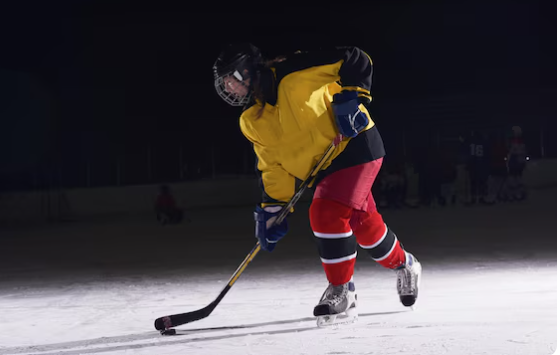

The puck flowed through space with that distinct, quiet authority that great sportsmen occasionally produce after leaving Jack Hughes’ stick in a flash. Before they even knew why, thousands of spectators stood up inside the Olympic arena. After the net rippled in less than a second, Hughes—who was still collecting his breath despite losing two front teeth—became a legendary figure in American athletics. He was just 24. However, he appeared older at that precise moment.
Hughes had looked down at the ice earlier that night and saw his own teeth laying there, strewn around like shattered plastic. Below him, the ice surface was speckled with blood. It’s difficult to ignore how hockey players respond to pain differently than the general public—almost irritated, more than scared. Knowing that the game was still more important than whatever he had lost, Hughes skated to the bench and wiped his mouth. Moments like those seem to have a greater influence on careers than any stat line ever could.
Important Information Table
| Category | Details |
|---|---|
| Full Name | Jack Rowden Hughes |
| Born | May 14, 2001, Orlando, Florida, USA |
| Nationality | American |
| Height / Weight | 5 ft 11 in (180 cm) / 175 lb (79 kg) |
| Position | Center |
| NHL Team | New Jersey Devils |
| Draft | 1st overall, 2019 NHL Draft |
| Olympic Achievement | Scored overtime winner for USA Gold Medal, 2026 |
| National Team | United States |
| Reference |
Hughes’ path to winning in OT has never been a straight line. He was born in Orlando but grew up surrounded by the quiet intensity of hockey because he was reared in hockey-obsessed homes. His family knew what was required. Quinn, his younger brother, would also become famous. They did more than simply play hockey. They carried it.
Expectations were high when Hughes was taken first overall by the New Jersey Devils in the 2019 NHL Draft. The weight of first overall selections is varied. The sound of each missed shot gets louder. Every slump turns into a discussion. Additionally, his early seasons weren’t flawless.
At times, he appeared smaller than the seemingly steel-built defenders, and he struggled. Critics questioned if he had been selected too high or too early. It was clear to feel the impatience surrounding him at the time, the understated strain that accompanies up-and-coming stars before they establish themselves.
However, Hughes continued to advance, becoming faster, more balanced, and better at making decisions. He started managing games rather than responding to them gradually, almost silently.
However, Olympic hockey is a distinct emotional realm. There are facets to the USA-Canada rivalry that extend beyond the rink. The air feels heavier, even when you’re warming up. Reactions get louder with each hit. Every error has repercussions.
Hughes committed one of such errors late in the gold medal match. A Canadian player was sent to the penalty box after his stick unintentionally struck him. He later acknowledged that he feared playing the villain while sitting there with his helmet on. He might have been sharpened by terror.
Something changed when he returned to the rink during overtime. The puck was recovered by the Americans. The play progressed swiftly. Hughes read the moment before it was completely formed and shifted into position almost automatically.
It was difficult not to observe the mixture of relief and delight when his teammates around him afterwards. Hughes remained silent. His smile was broad, unfinished, and full of missing teeth. Resilience seems to be valued more in hockey than perfection.
It wasn’t a sudden aim to win a gold medal. It was constructed after years of modest growth in New Jersey, where Hughes had gradually developed into one of the most innovative hubs in the NHL. When he carried the puck, supporters inside the Prudential Center leaned forward a little, anticipating his next move. Olympic success, however, alters perception in a manner that regular seasons cannot.
Videos of Hughes went viral in the days following the victory. On frozen ponds, kids imitated his overtime shot. His position among the league’s elite was disputed by analysts. His teammates praised his poise and his ability to handle pressure.
Whether that incident will define his entire career or perhaps be one chapter in a longer story is still up in the air.
It is rare for athletes to adhere to tidy narratives. Some people reach their peak early. Others change gradually. Hughes appears to be in the middle, continuing to develop and learn. He is still closer to the beginning than the end at the age of twenty-four.
But he will always be remembered when he skated off the Olympic ice, holding gold and grinning through blood.

