
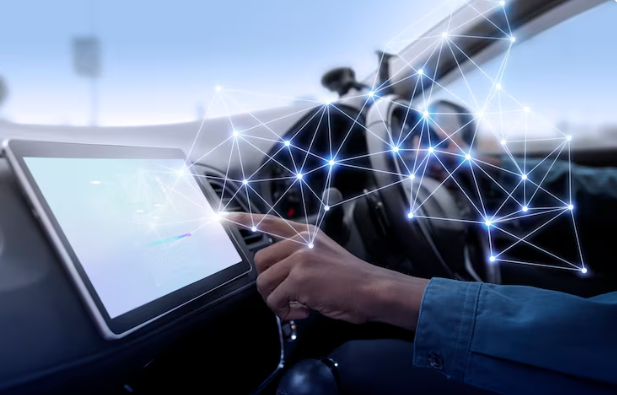

Mobility feels less like a system and more like controlled chaos at certain congested intersections, when automobiles are inching ahead, pedestrians are lingering at the curb, and a delivery rider is navigating between traffic. It’s difficult to see how anything as ethereal as artificial intelligence could bring order to what’s happening. However, AI is already present in these situations in a subtle, nearly undetectable way.
Mobility has changed in waves during the last three centuries. Cars transformed cities, railroads connected far-flung areas, and airplanes compacted continents into hours. Though less evident at the time, each change seemed enormous in retrospect. The AI-driven change of today feels different. It’s more dispersed, less obvious, and developing through numerous tiny tweaks rather than a single invention.
Key Information About AI in Mobility
| Category | Details |
|---|---|
| Topic | AI in Mobility |
| Focus Areas | Transportation systems, automation, safety, sustainability |
| Key Study | MIT Mobility Initiative & Kearney Advanced Mobility Institute |
| Scope | 55 global organizations |
| Core Applications | Network planning, autonomous driving, logistics, materials discovery |
| Key Challenge | Integration across systems |
| Core Priorities | Safety, inclusivity, sustainability |
| Emerging Trend | Human–AI hybrid systems |
| Industry Type | Transportation / Technology |
| Reference Website |
According to a new study involving over 50 firms in the global mobility ecosystem, artificial intelligence is already having an impact on almost every aspect of transportation. Its uses are numerous, ranging from forecasting fleet maintenance problems to optimizing traffic patterns. However, the fact that these efforts are still so dispersed is noteworthy. Many of the most promising concepts are isolated pilots that perform well in confined environments but have difficulty expanding.
There is a belief that coordination, rather than technological prowess, is the true obstacle. Although AI is capable of data analysis, route suggestions, and decision-making, mobility systems require layers of human behavior, regulation, and infrastructure. Creating an algorithm is more simpler than aligning those components. Whether the public and commercial sectors can advance swiftly enough to stay up with the technology itself is still up for debate.
You start to realize how much of the experience is already mediated by digital systems when you stroll through a contemporary transit hub—screens updating arrival times, passengers checking applications for delays. AI improves these tools by increasing their responsiveness and predictability. However, rather than being revolutionary, the advancements frequently feel gradual. Trains continue to operate on tracks. The busses continue to travel along roadways.
One of the most important and possibly most delicate concerns is still safety. Unlike other businesses, mobility does not allow for mistakes. There are real, immediate risks associated with a traffic management or autonomous driving error. This is referred to by researchers as a “jagged frontier,” where AI exhibits remarkable performance in certain tasks and unpredictable performance in others. It becomes crucial to design systems that strike a balance between machine precision and human judgment.
This interaction has an almost paradoxical quality. Though the reality is more nuanced, one might anticipate AI completely replacing human decision-making. The most realistic solution is turning out to be hybrid systems, in which humans and AI share responsibility. Even as algorithms play increasingly complicated roles, drivers, operators, and controllers continue to be involved. It’s unclear if this equilibrium will endure over time.
Beyond efficiency, AI holds great promise for mobility. Interest in how it might help achieve more general social objectives, such as lowering emissions, increasing accessibility, and enhancing the safety of transportation, is developing. Given the demands placed on contemporary cities, these goals are both desirable and practically essential. However, technology alone is not enough to achieve them. It necessitates agreement on governance structures, data standards, and regulatory strategies that differ greatly between geographical areas.
It’s difficult to ignore how uneven this growth is on a global scale. While some towns struggle with basic infrastructure, others experiment with AI-driven traffic systems. Another factor is trust. The public’s acceptance of AI differs depending on cultural beliefs and prior technological experiences. While there is enthusiasm in some areas, doubt persists in others.
All of this ingenuity has a useful aspect that is frequently overlooked. AI is being used to monitor crowd movements in real time, manage logistical networks, and find new materials for automobiles. Although these applications don’t garner much attention, they subtly alter the way mobility systems operate. They increase reliability, cut down on delays, and increase margins—small benefits that add up over time.
As technology develops, there’s a sense that mobility is shifting away from individual cars and toward interconnected systems. Drones, cars, trains, and even pedestrians are all a part of a bigger network that is becoming more and more data-driven. Though not always smoothly, AI serves as the thread that ties these components together. There are still a lot of gaps between systems—different platforms, conflicting interests.
Therefore, whether AI will alter mobility is not the question. It has already done so. How far that transition will go and how soon it will become unified rather than disjointed are the questions. Although they are aware of the difficulties in execution, investors appear to have faith in the long-term potential. The greater the aim, the more difficult it is to fulfill.
All of this has a subtle tension to it. On the one side, AI provides technologies that could improve safety, cleanliness, and inclusivity in transportation. However, it adds complexity and raises fresh concerns about trust, accountability, and control. It is difficult to ease such strain.
Even if it’s not immediately apparent, it becomes evident that the transformation is already taking place as you stand at that same junction once more and observe the erratic traffic flow. The pandemonium isn’t being completely replaced by AI. One change at a time, it is gradually and unevenly transforming it. And maybe that’s how most significant change occurs—gradual changes that only become apparent in retrospect rather than abrupt leaps.

