
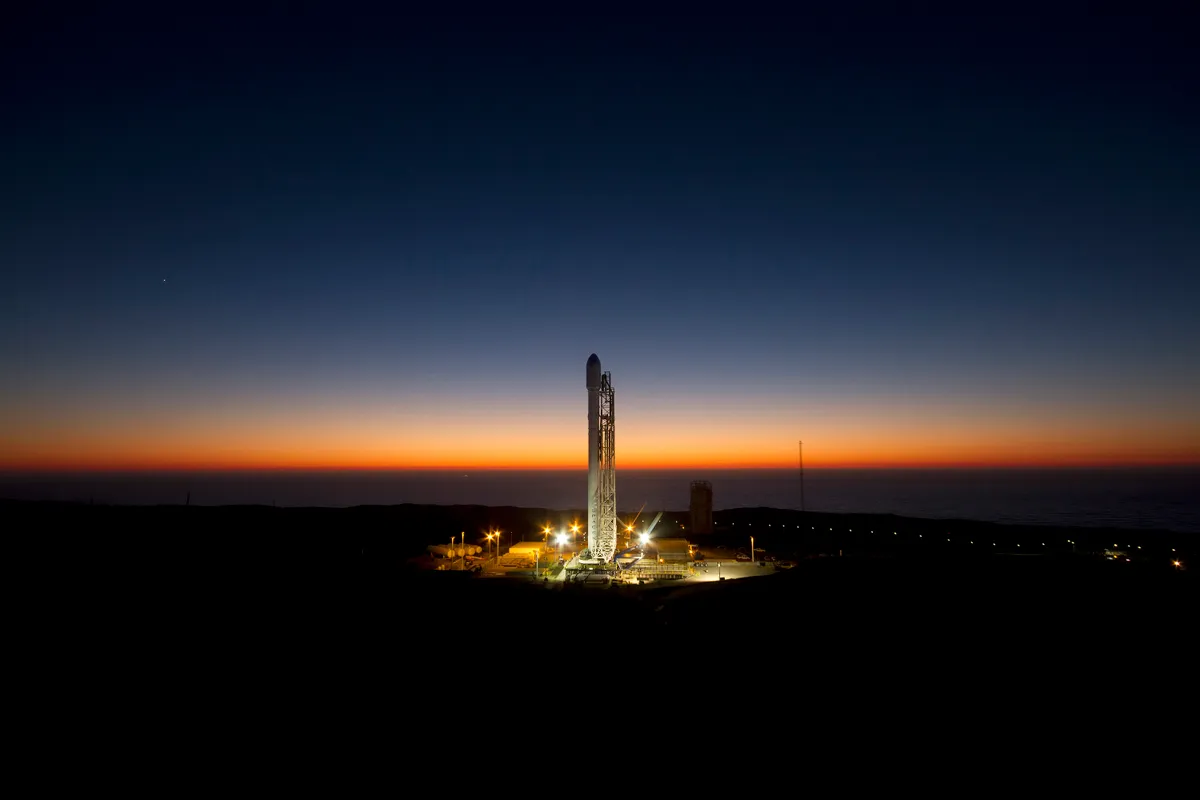

The SpaceX IPO hedging challenge confronting Wall Street is unlike anything institutional investors have faced in a generation. Yahoo Finance confirmed the company set its IPO price at $135 per share ahead of its Friday debut on the Nasdaq, under the ticker SPCX. The problem is not the price. The problem is that nothing else on the market behaves like SpaceX.
Dennis Davitt, chief investment officer at Millbank Dartmoor Portsmouth, has sat through blockbuster IPOs before. He was at Credit Suisse when Google went public in 2004. He is not short of context. But even he concedes the comparison only goes so far.
‘This reminds me a lot of, like I used to work at Credit Suisse in 2004 when we IPOed Google,’ Davitt said. ‘Hedging it back then was easier because there were more things to sell. So when you put a hedge together on something like this, you create a basket of things that simulate the price action… but there’s nothing to sell in SpaceX.’
The punchline he reaches for captures it cleanly: ‘What are you going to do, short NASA?’
The SpaceX IPO Hedging Challenge Has No Clean Proxy
For institutional investors who built positions in SpaceX through private markets, the urgency of this question is practical, not rhetorical. The company’s private market valuation has nearly tripled in the past year, according to Forge data. A position that has tripled is a position that now dominates a portfolio, and a dominant position demands a hedge. Without a comparable public company to short against it, investors are left assembling proxies that will only loosely track the underlying.
The underlying, in this case, is a business whose financial profile defies easy categorisation. According to an Investing.com analysis, Starlink accounted for over two-thirds of revenue in the most recent quarter and generated a $1.2 billion profit. Meanwhile, SpaceX’s AI venture lost $2.5 billion in Q1 2026 alone, following a $6.4 billion loss across all of 2025. Revenue engine in one segment, cash furnace in another.
Adding to the complexity, CNBC’s IPO live coverage reported that Anthropic will pay SpaceX $1.25 billion per month through May 2029 for compute capacity at the Colossus 1 data centre in Memphis, Tennessee. That is a contract that has no peer on any public market. SpaceX also struck a deal to acquire Cursor for $60 billion as part of its overhaul of xAI’s business and technology, according to the same CNBC coverage.
Davitt’s expectation is that first-day fireworks will be limited. ‘My instinct, being old, is and having been around these bigger IPOs like this, is that it tends not to be that crazy 200% blow-off top,’ he said. ‘I do not believe that Elon Musk is going to allow this to IPO at $135 and trade up to $270 the first day.’
A Float of 5%, a Dual-Class Structure, and a Calendar Full of Noise
Price discipline from management is not the only constraint on volatility. According to the Investing.com analysis, SpaceX is floating only approximately 5% of its stock in the offering, making the capital raise structurally modest relative to the implied valuation. A thin float means thin liquidity, and thin liquidity means wide spreads from the opening bell.
The SpaceX S-1 filing with the SEC establishes a dual-class share structure in which Class B shareholders are entitled to elect a majority of the board. Elon Musk, who serves as founder, CEO, CTO, and chairman, holds voting control through both Class A and Class B common stock, with the majority of that control exercised through Class B shares. The S-1 was filed on 20 May 2026 and became effective on 11 June 2026, according to an SEC EFFECT filing reported by StockTitan.
Brent Kochuba, founder of Spotgamma, sees the options market as the flashpoint. ‘I think the initial SPCX markets are going to be pretty challenging for traders meaning super wide and with a very high IV,’ he said via email. ‘Not only is the price action of the stock under question, but you have these levered ETFs which are going to launch, and then forced index buying. Compounding that are the FOMC meeting and VIX expiration on the next day (17th), followed by a massive June options expiry.’
Those leveraged vehicles are already registered. Leverage Shares has filed both a 2x Long SPCX Daily ETF (SPCH) and a 2x Short SPCX Daily ETF (SSPC). A separate SEC registration statement (Form 485APOS) describes a fund aiming to achieve twice the income from selling options on SpaceX common shares, by selling options on those same leveraged ETFs.
On the analyst side, Oppenheimer initiated coverage with an Outperform rating and a price target of $190, implying roughly a 40% gain from the IPO price. That is bullish. It is also, as Davitt would note, still just one data point in the absence of a real comp.
The SpaceX IPO hedging challenge does not resolve itself after the opening print. With a locked-up majority, a wafer-thin float, and leveraged derivatives layering on top, the volatility question shifts from Friday’s session to the weeks that follow, as index inclusion mechanics and options market structure settle into place around a stock that has, by design, very little room to breathe.

