
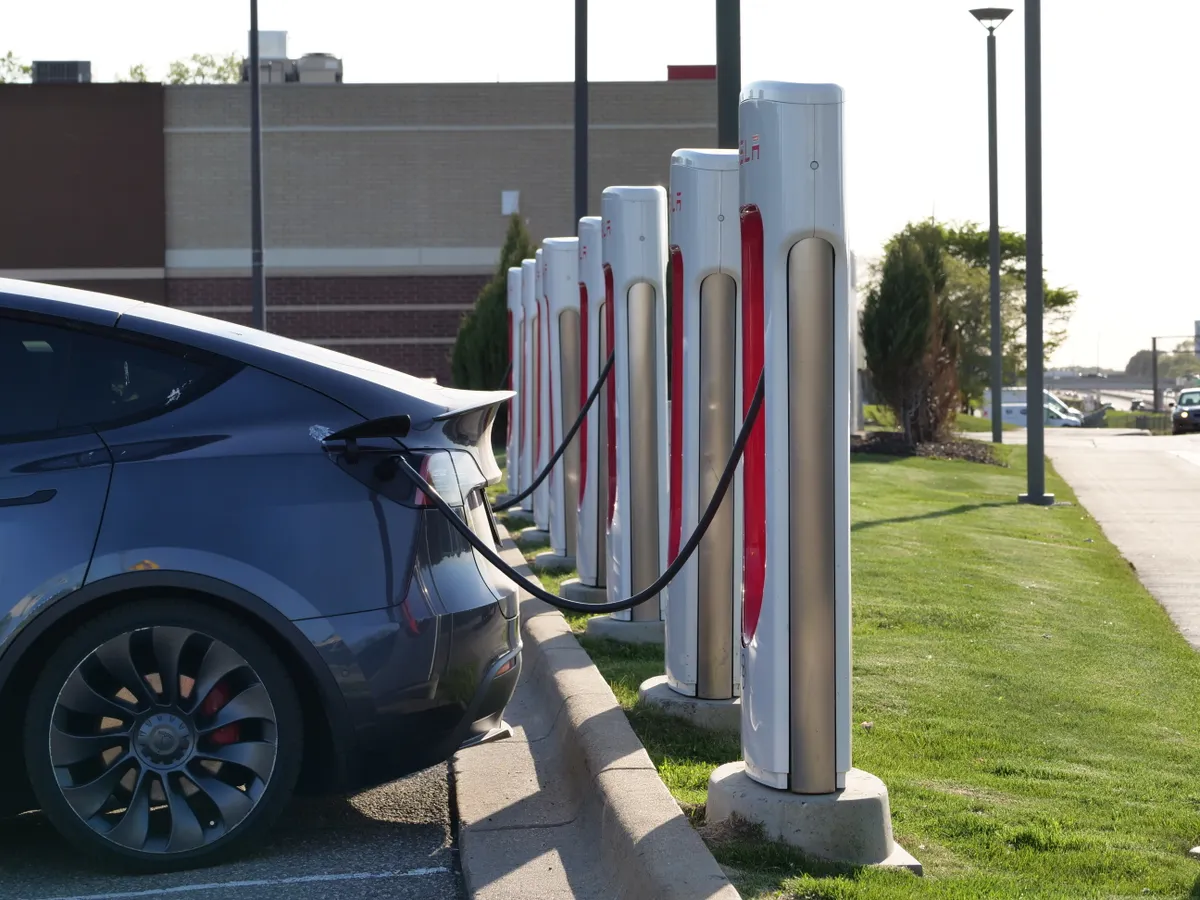

EV fast charging reliability has quietly undergone one of the more credible turnarounds in consumer technology, and a 600-mile round trip to Montreal this summer put that improvement to the test. The result was near-flawless: three charging stops, roughly 20 minutes each, zero queues, and a single app hiccup at a station just outside the city.
Three years ago, the same driver made a shorter trip, about 350 miles to Maine and back, in the same Audi e-tron. That experience required three calls to customer service, two broken stalls, and a charging session that refused to end properly before a second one would begin. The contrast is the story.
From Broken Stalls to a 600-Mile Road Trip
The Montreal trip was planned around the Kia EV9, which can travel close to 300 miles on a charge. When the Kia went into the shop for a broken air conditioner, the e-tron stepped in, offering roughly 220 miles of range per charge. Two sessions on the way up and one on the return handled the distance without drama.
Route planning came courtesy of A Better Routeplanner (ABRP), an app that accounts for temperature, wind, battery degradation, and vehicle specifications to optimise charging stops. TechCrunch reported that the app was originally a hobby project started in 2016 by Bo Lincoln, who later founded the Swedish company Iternio in 2018. Rivian acquired Iternio in June 2023. At the time, chief executive RJ Scaringe said ABRP ‘leads the way in EV trip planning and is an important platform for driving EV adoption.’
ABRP directed the driver to a Rivian charging station near Lebanon, New Hampshire. Six 300-kilowatt chargers, all operational, with a grocery store and food options alongside. The charger accepted a credit card without requiring the Rivian app and delivered over 140 kilowatts, near the e-tron’s maximum. The same stop worked identically on the return leg.
One wrinkle: a Circuit Électrique station near Montreal had a broken card reader, requiring a downloaded app and a 20 Canadian dollar top-up before the session ran cleanly. That aside, the three sessions combined took roughly as long as the border-control wait coming back into the United States.
It is worth noting that ABRP’s own acquisition announcement stressed the app would remain an open platform for all EV drivers and brands, not a Rivian-exclusive tool. In June 2024, ABRP 5.0 added live over-the-air vehicle data via Enode for almost all EV brands, free real-time charger status, and a Rivian Charging Score, available to US and Canadian users at no charge.
EV Fast Charging Reliability: What the Data Actually Shows
The anecdote lines up with a structural shift in the numbers. In July 2023, the US had roughly 32,000 DC fast chargers, according to the Joint Office of Energy and Transportation. Many were restricted to Tesla drivers at the time. Today, that total has more than doubled, with Tesla’s network now open to most EV drivers alongside continued expansion by other networks.
Reliability has followed. Paren’s charger reliability data, which covers more than 95% of US DC fast-charging infrastructure and processes over 100 million data events per day, put the national average reliability score at 93.5 in Q1 2026, up from approximately 85% to 92% the prior year, consistent with the roughly ten-point improvement described by observers of the network.
The gains are not confined to Tesla. A Paren report covering non-Tesla networks put the non-Tesla US reliability index at 82.6 in Q1 2025, up 1.4 points from Q4 2024’s score of 81.2. Paren noted that the Tesla Supercharger network was excluded from that index precisely because it is known to operate at a higher baseline. Gaps persist: Oklahoma registered 77.7 on Paren’s index, the lowest of any state in Q1 2026.
For prospective buyers who still cite public charging infrastructure as a key concern, the gap between perception and current reality has widened considerably. The chargers break less often, and when they do break, repairs are coming faster. None of that is universal yet. But the 600-mile data point is less of an outlier than it would have been three years ago.
The next real test will be summer holiday season volumes: whether networks that perform well in light-traffic conditions hold up when half of New England heads north at once.

