
Kazakhstan is Building Its Future Through Eurasian Trade Corridors and AI Economy

Contributed content: this article was written by a third-party contributor and does not necessarily reflect the views of Fortune Herald. Editorial and Advertising Policy
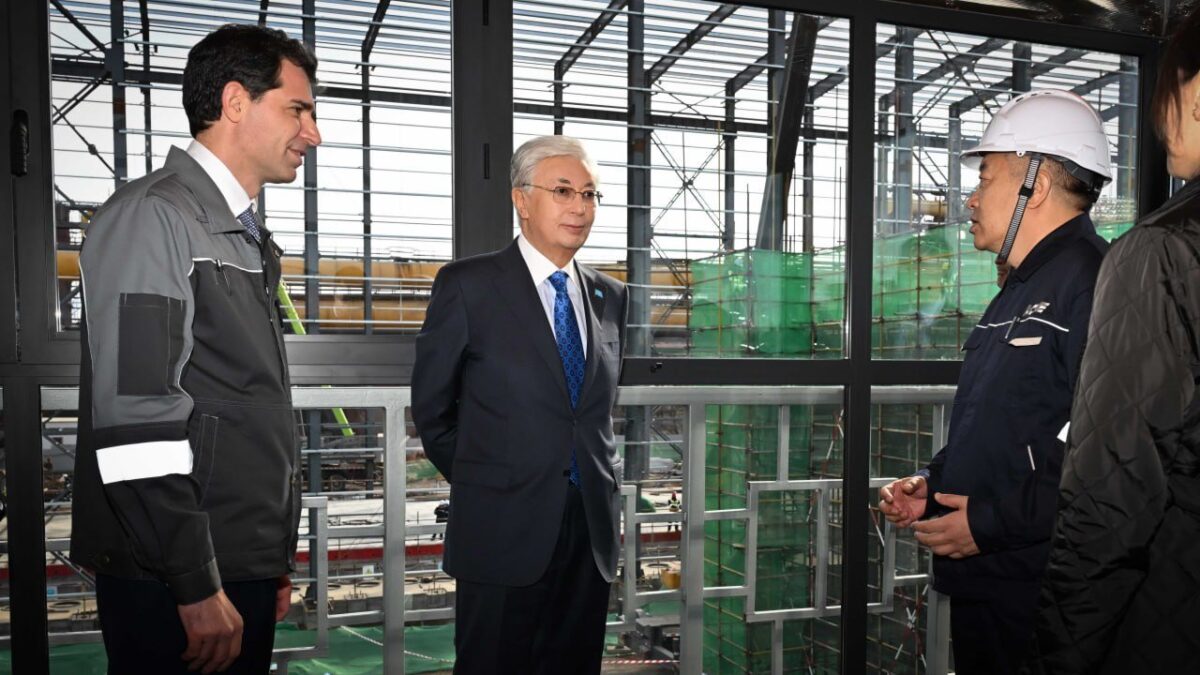
At a time when artificial intelligence dominates discussions of economic progress, Kazakhstan’s President Kassym-Jomart Tokayev has offered a tangible answer to the question of how countries prepare for the future: build. In his State of the Nation Address of 28 October 2026, he called for Kazakhstan to become “one vast construction site” and proposed designating 2027 the Year of Nationwide Large-Scale Construction.
The message can be distilled into three words: build, build, build. This is a literal programme of construction, stretching from railways, roads and airports to power stations, hospitals, schools and local utilities. But the economic ambition extends beyond the building sites themselves. As Kazakhstan approaches its 35th anniversary of independence, Tokayev is presenting physical infrastructure as the foundation for the country’s next economic chapter, one with consequences well beyond its borders.
Building the foundations of growth
At the centre of this strategy is “People’s Construction”, a nationwide programme to build and modernise hospitals, schools, transport networks, utility systems and other essential facilities. The government is to prepare an Infrastructure Modernisation Plan, with approximately $14 billion allocated from the National Fund by the end of 2029, including for social projects during 2026 and the first two months of 2027.
The economic reasoning is significant. Kazakhstan has accumulated substantial national savings from its natural resources, but Tokayev argues that its responsibility to future generations is “not simply to leave money in bank accounts”. Productive infrastructure offers another form of inheritance: stronger regional economies, improved public services and greater capacity for future industries. The address explicitly calls for public investment to deliver economic and social returns.
This is also an industrial policy. The President wants new infrastructure to create demand for domestically produced construction materials, metal structures and engineering equipment, with small and medium-sized enterprises involved in delivery. Manufacturing already accounts for more than 14% of GDP, according to the address. Linking construction expenditure to local suppliers could help extend diversification beyond the extractive industries, while international firms contribute specialised technology, expertise and longer-term capital.
By increasing demand for local materials and expertise, construction could support production and skills far beyond individual project sites. That logic also underpins Kazakhstan’s investment in international transport.
Building the connections of Eurasia
Kazakhstan’s position between China, Central Asia, the Caspian Sea and Europe gives it a pivotal role in overland connectivity. Tokayev has said that roughly 85% of overland freight moving between China and Europe passes through Kazakhstan. Although ocean shipping carries much larger volumes overall, this land-based traffic matters to firms seeking additional Eurasian routes. According to Samruk-Kazyna’s 2025 annual report, Kazakhstan’s railway network handled 33 million tonnes of transit freight that year, highlighting the scale of its existing logistics role.
The Trans-Caspian International Transport Route, or Middle Corridor, provides a further route between Asia and Europe through the Caspian Sea and South Caucasus. Kazakhstan’s Transport Ministry reported approximately 77,000 twenty-foot equivalent units (TEU) of container traffic along the route in 2025. For China, this adds a transport option towards European markets; for European companies, it can broaden access to Central Asian suppliers, customers and industrial partners.
The address sets out the next stage of construction. The Bakhty-Ayagoz railway, scheduled to become operational in 2027, is intended to add 20 million tonnes of freight capacity towards China. Tokayev also highlighted the Aral-Caspian corridor, designed to shorten the Trans-Caspian route by around 1,000 kilometres. He called for widening the Kokshetau-Petropavl road, reconstructing road border crossings and building a modern airport in Astana, extending the programme across rail, road and aviation.
Importantly, this expansion is not starting from zero. The second track of the 836-kilometre Dostyk-Moiynty railway was commissioned in September 2025, with the potential to increase capacity from 12 to 60 train pairs per day. At the Caspian end, the Aktau International Container Hub received its first container train in July 2026 and is being developed to expand the port’s annual container-handling capacity.
In February, the World Bank approved an $846 million guarantee intended to mobilise $1.41 billion for railway development, including a new 322-kilometre connection that would remove a significant detour. A separate World Bank assessment estimated that improvements across the wider Middle Corridor could more than triple its trade volumes by 2040. The European Union, Kazakhstan’s largest trading and investment partner, recorded €41.4 billion in goods trade with the country in 2025.
For Kazakhstan, the commercial opportunity goes beyond earning transit fees. Logistics parks, freight consolidation centres, manufacturing sites and digital border systems can make the country a more active participant in supply chains. This is why Tokayev’s call to build transport infrastructure matters to both Kazakhstan’s industrial prospects and the companies trading across Eurasia.
Building the infrastructure of the digital age
The same logic applies to the digital economy. AI may appear weightless, but its foundations are physical: power stations, transmission lines, substations, data centres and fibre-optic cables, as well as the skilled workers to operate them. Tokayev’s address calls this the “Age of Electricity” and sets a target of achieving a sustained national electricity surplus by 2029, supported by new generation, grid modernisation, renewables and nuclear power development.
Investment is already extending into the networks that support this transition. The European Bank for Reconstruction and Development is providing a loan of up to $225.6 million for upgrades to electricity distribution in the Almaty region, including smart metering. Better grid reliability is essential not only for households and factories but also for the more energy-intensive computing infrastructure Kazakhstan hopes to attract.
Perhaps the clearest illustration of the connection between construction and global technology came shortly before the address. On 15 October, Kazakhstan and Azerbaijan inaugurated a 380-kilometre fibre-optic cable across the Caspian Sea. The line creates another high-capacity communications link between Central Asia and Europe. It gives the Middle Corridor a digital dimension: goods can move through its transport infrastructure while data travels through a complementary network.
Kazakhstan is also seeking a larger role in cloud computing and AI infrastructure. At Ekibastuz, the planned Data Center Valley envisages capacity that could eventually reach one gigawatt; the government reported in April that a 215 MW substation had been acquired and discussions held with international technology companies. This is prospective capacity, not an operating global computing hub. Nevertheless, the combination of land, power infrastructure and stronger international connectivity offers a plausible basis for regional data-centre services and cross-border digital investment.
Tokayev also wants a “people’s digital economy” in which rural producers use digital platforms and logistics networks to reach customers. The purpose of these new networks is therefore not only to attract international technology investment, but to give smaller businesses new routes to market.
Building for people and future generations
Construction has an equally direct social dimension. Kazakhstan has nearly seven million children (34% of its population) and growth in population and internal migration is increasing demand for schools, healthcare and utilities. Tokayev’s programme therefore treats social infrastructure as part of economic development rather than merely as a budgetary cost.
Its first phase envisages approximately 70 healthcare facilities and 50 educational, cultural and sporting facilities. Eight new perinatal centres and seven multidisciplinary children’s hospitals feature among the more specific commitments. Tokayev stressed that new construction and renovation should reach every regional centre, district and village, with better housing, clean water, gas supplies and other facilities in smaller communities.
Hospitals and schools also make regions more attractive to families, employers and investors, supporting the workforce on which advanced industry depends. Proposed digital twins for urban planning show how technology can make new buildings and utilities more efficient.
The financing model goes beyond the National Fund: Tokayev envisages greater involvement from banks, development institutions and private investors, including public-private partnerships. His proposed Investment Court in Alatau, modelled on English common law, is part of the effort to attract capital for major development projects.
The underlying proposition is that Kazakhstan’s future will take shape through tangible projects: railway tracks, highways and airports; power stations and data cables; hospitals, schools and utility networks. Their economic significance reaches further, connecting businesses, enabling digital services and widening opportunity for Kazakhstan’s citizens. That is the meaning of Tokayev’s declaration that the response to the age of AI is “to build, and, I repeat, to build!” For Kazakhstan and its international economic partners, the nationwide construction programme is intended to support the next generation of growth.