
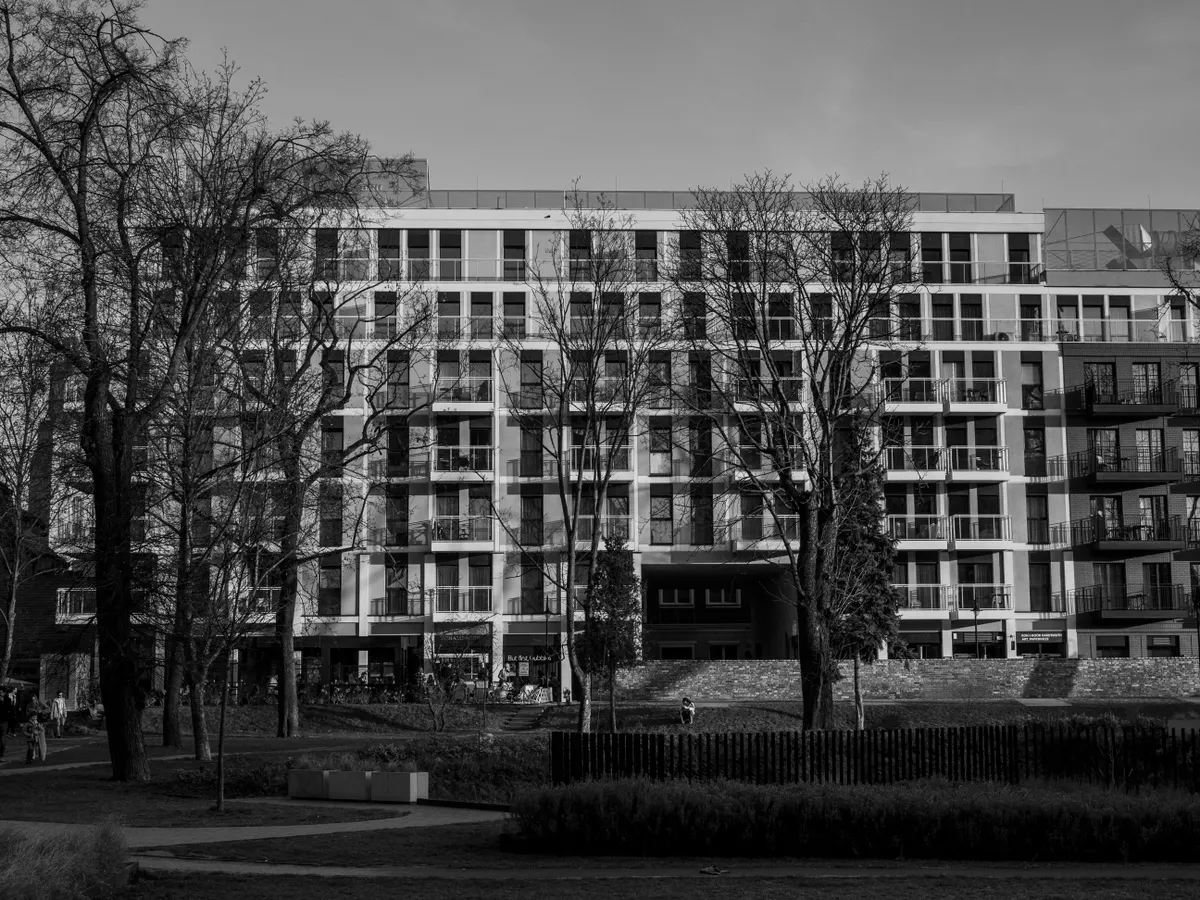

Lift House London founders are building something that would look odd by Silicon Valley standards: a six-storey co-living space in East London where Sunday journaling replaces Demo Day countdowns, and volleyball on Tuesdays is a fixture rather than a treat.
The house, officially called the London Island Founder House, launched in March. Rowan Aldean, 26, who sold a previous company last year and now runs an applied AI startup, lives there with his wife Zahraa, 22, a forthcoming pharmaceutical research PhD candidate. Four other founders round out the current cohort, ranging from a brain-coaching entrepreneur to a tech strategist who hosts rooftop dinners drawing investors and operators from across the city.
Aldean named the project after its lift, the elevator at the centre of the building, and after the ambition to uplift the people inside it. The ethos is deliberate. ‘I don’t expect the performative and over-the-top events will be a thing here,’ he said, pointing to DeepMind as his reference point. ‘They’ve won Nobel prizes and built frontier innovation without any song and dance.’
A London AI Boom Gives the Lift House London Founders a Tailwind
The backdrop matters. London AI startups raised $12 billion in the year to date in 2026, out of $14.7 billion raised by all London startups, according to Dealroom. Six companies have crossed the $500 million mark: Wayve, Superintelligence, ElevenLabs, Recursive, Ineffable Intelligence, and Isomorphic Labs.
The scale of some of those rounds is eye-catching. ElevenLabs closed a $500 million Series D at an $11 billion valuation, more than tripling its valuation from the prior year in a round led by Sequoia Capital; total funding since its 2022 founding reached $781 million.
Ineffable Intelligence, founded in late 2025 by former Google DeepMind reinforcement-learning lead and UCL professor David Silver, raised $1.1 billion in seed funding at a $5.1 billion valuation, the largest seed round ever recorded in Europe. Sequoia Capital and Lightspeed Venture Partners co-led, with participation from Nvidia, Google, DST Global, and the UK government’s Sovereign AI Fund, among others; the British Business Bank contributed $20 million. The company is focused on reinforcement learning, where AI models learn from experience rather than from human-labelled internet text, according to CNBC.
Recursive Superintelligence, founded in 2025 by former leaders from OpenAI, Google DeepMind, Meta AI, and others, raised $650 million and operates across San Francisco and London with more than 25 researchers and engineers. AMD Ventures and NVIDIA both participated in the round.
On a rolling 12-month basis to end of Q2 2026, Dealroom places London AI funding at $16.2 billion, second globally behind the Bay Area and just ahead of New York City at $15.9 billion. (That figure covers a different time window from the year-to-date 2026 total cited by the same data provider.) According to a FF News report on UK VC in Q1 2026, the UK added seven new AI unicorns in the first quarter alone and creates roughly twice as many AI startups and unicorns as any other European country, with four of Europe’s top 15 AI hubs located in the UK.
The Anti-Hustle Pitch, Backed by Tax Incentives
Inside Lift House, the rhythm runs counter to the Valley archetype. Residents journal together on Sundays, a habit introduced by David Amor, 28, whose company helps founders understand brain function and business performance. The journals track time in nature, diet, and exercise, not sprint velocity. Luke, 27, who co-runs an AI-marketing company, said he now makes sure to eat lunch, ‘which is something that is simple, but I wasn’t doing before I lived here.’
Tuesday evenings are for volleyball in a local league. Wan Ying L, 25, a founder between startups, plays piano after dinner. Presence Plumb, 25, a tech strategist, holds rooftop dinner parties where dishes from Iraqi to Spanish cooking reflect the house’s mix of nationalities. ‘It’s a bit calmer, balanced, authentic in a way,’ she said of the broader London ecosystem. ‘They don’t want too much of that only startup tech bro vibe.’
The financial architecture of early-stage building in London also helps. Luke and his co-founder Varun, 27, have leaned on the UK government’s Seed Enterprise Investment Scheme and Enterprise Investment Scheme rather than traditional venture capital. Under SEIS, qualifying companies can raise up to £250,000 while investors claim up to 50% income tax relief on investments up to £200,000 per year, plus a capital gains tax exemption after three years of holding. More than 90% of all angel investment in the UK flows through SEIS or EIS, according to a Dealum overview of the schemes. ‘There’s people who will pay basically the same rate of tax if they give us the money versus if they pay income tax,’ Luke explained.
The tension the house embodies is a London-wide one. Aldean acknowledges that the ecosystem is ‘bullish on the country until they get the opportunity to leave.’ Luke and Varun have started their US expansion and haven’t ruled out relocating to be closer to customers. An investor in Miami already pressed them on the point. The Lift House lease runs about a year longer, and the group wants to extend it. Whether the founders stay in London long enough to test their own anti-burnout thesis is the question that will answer itself.

