
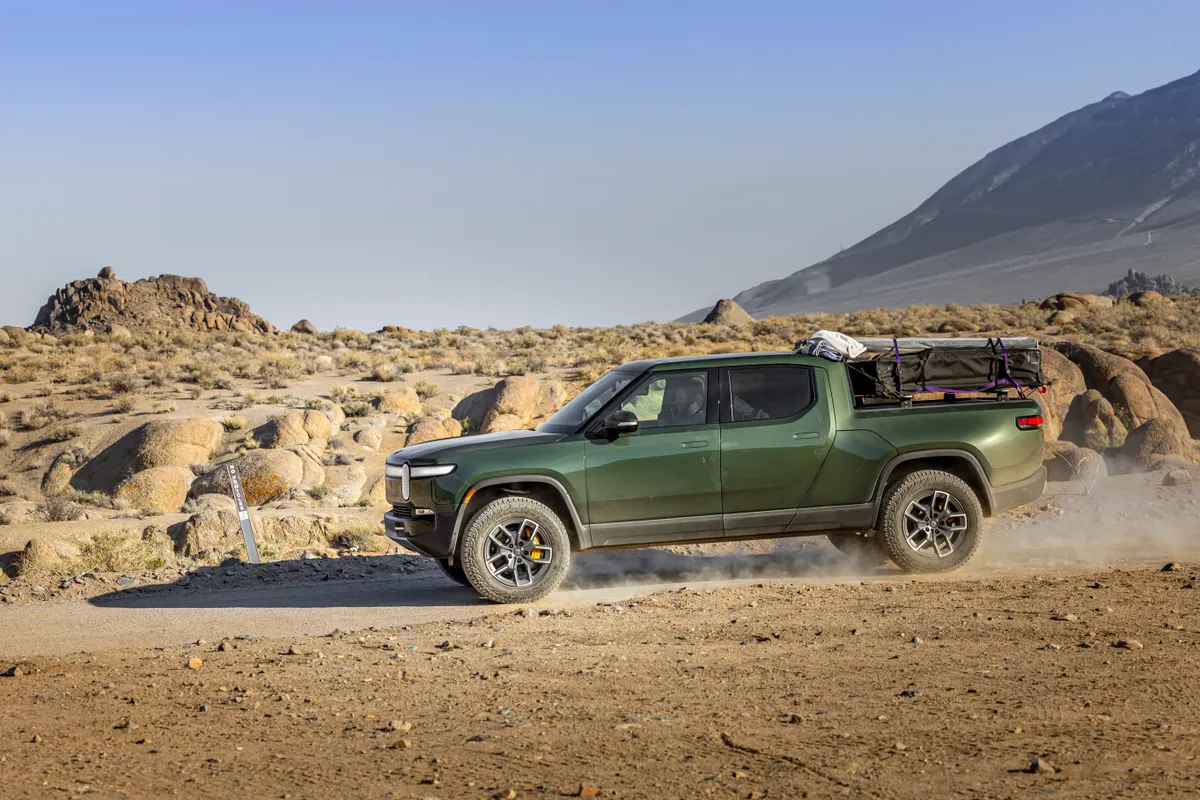

The Ford Fathom EV pickup will start at $29,945 including destination charges, Ford confirmed, setting up what the company hopes is a pivotal moment in its long struggle to crack the electric vehicle market. The price breaks down as a base of $28,350 with a $1,595 destination and delivery fee, landing well below the $56,000 average for new EVs and the $50,000 average for new vehicles broadly.
On paper, the value proposition is hard to argue with. The Fathom undercuts the so-called Keating Line, the average listing price of the largest price segment available at dealers, by around $5,000. It also beats the upcoming Slate Truck, a rival compact EV pickup starting at $26,400 with an estimated range of 205 miles, on range: WardsAuto reports the Fathom’s standard-range battery is rated for approximately 300 miles of EPA-estimated range. Ford is not just pricing for volume; it is pricing to reframe what an affordable electric truck can be.
Chief executive Jim Farley has called the Fathom and its underlying Universal EV platform a “Model T moment” for the company. Ford’s newsroom describes a $5 billion investment in the UEV platform, which replaces the traditional assembly line with what the company calls an “assembly tree”: three sub-assemblies running simultaneously on their own lines before converging. It is an ambitious rethink of how a mass-market vehicle gets built.
Ford Fathom EV Pickup and the Compact Truck Problem
Yet ambition in the factory does not automatically translate to demand in the showroom. Ford’s own Maverick offers the most honest benchmark available. The Maverick peaked at 157,345 units in 2024 before slipping 1.5% to 155,051 in 2025, steady numbers but not the category-defining volumes Ford needs. The Taurus, at its 1992 peak, sold more than twice that figure. The compact truck segment is growing, but it has a ceiling.
The Fathom does bring some genuine advantages over its stablemate. Farley told investors on Ford’s second-quarter call that the truck will offer more passenger volume than a Toyota RAV4, according to WardsAuto. It will also include a frunk, a detail that could attract buyers who have long dismissed pickups for their lack of enclosed storage. Still, the body style cuts against the grain of where the market sits today. Cox Automotive data cited in the original analysis puts more than 70% of prospective buyers shopping for an SUV, against 33% for pickups.
Among pickup buyers, the Fathom faces a further hurdle: the truck as cultural artefact. Buyers who want a pickup tend to want one that looks purposeful, even rugged. General Motors, in a recent industry briefing, emphasised its focus on delivering the “lifted trucks” its customers are requesting. From what Ford has shown publicly, the Fathom does not lead with that aesthetic.
Then there is the EV adoption question. Consumer resistance to battery-electric vehicles remains a real friction point, particularly in truck segments where range anxiety and towing concerns loom large. Ford can invest in dealer training and marketing, and a ruggedised variant of the Fathom seems almost certain to follow. But those are tools for moving the needle incrementally, not for generating the kind of demand surge Ford needs to justify a $5 billion platform bet.
A Platform Bet, Not a Sales Bet
The financial stakes sharpen the picture considerably. Ford’s Model e business unit has been generating billions of dollars in annual losses, and CNBC reports the UEV platform is central to bringing that unit to breakeven by 2029. Ford’s full-year 2025 Form 10-K shows consolidated revenues of $187,267 million, a healthy top line that masks how much the EV unit is costing the broader group.
Against that backdrop, the Fathom may be better understood as a calibration exercise than a volume play. Preorders open in early 2027, with customer deliveries expected later that year, according to CNBC. That timeline gives Ford room to validate the assembly-tree process, absorb early production lessons, and refine the platform before extending it to higher-volume segments, most likely SUVs, where the real sales potential lies.
Ford sold 2.2 million vehicles in the United States in 2025, its best annual result since 2019, finishing third behind Toyota Motor and General Motors, according to CNBC. That is solid performance, but it is still less than half the 4.48 million units the company moved at its peak in 2000. The Ford Fathom EV pickup is unlikely to close that gap on its own. The model that eventually does will probably ride the same UEV platform; the Fathom just needs to prove the platform works first.

