

Gritt solar construction robots emerged from stealth this week with a $26 million Series A round, betting that AI-controlled machinery can solve one of the clean-energy transition’s least glamorous bottlenecks: finding enough hands to actually install the panels.
The San Francisco-based startup, according to FinSMEs, was founded by two Carnegie Mellon-trained roboticists, CEO Puneet Puri and CTO Vishal Dugar. The Series A was led by Obvious Ventures, with Union Square Ventures and Active Impact Investment also participating.
The round brings Gritt’s cumulative fundraising to either $34 million, as the company has stated, or $32.4 million, as Robotics & Automation News and other outlets including Dealroom and FinSMEs report, a discrepancy the company has not publicly explained. The earlier seed round included backing from First Round Capital, Climactic, Congruent Ventures, and VSC Ventures. Congruent Ventures confirmed it backed the co-founders in a 2024 pre-seed round.
Gritt Solar Construction Robots and the Labour Gap
The problem Gritt is chasing is structural, and the numbers are sobering. Construction productivity has fallen 46% since 1965, a backdrop that Robotics & Automation News noted in connection with the fundraise. Solar installation, one of the fastest-growing construction categories on the planet, is running into that same productivity ceiling.
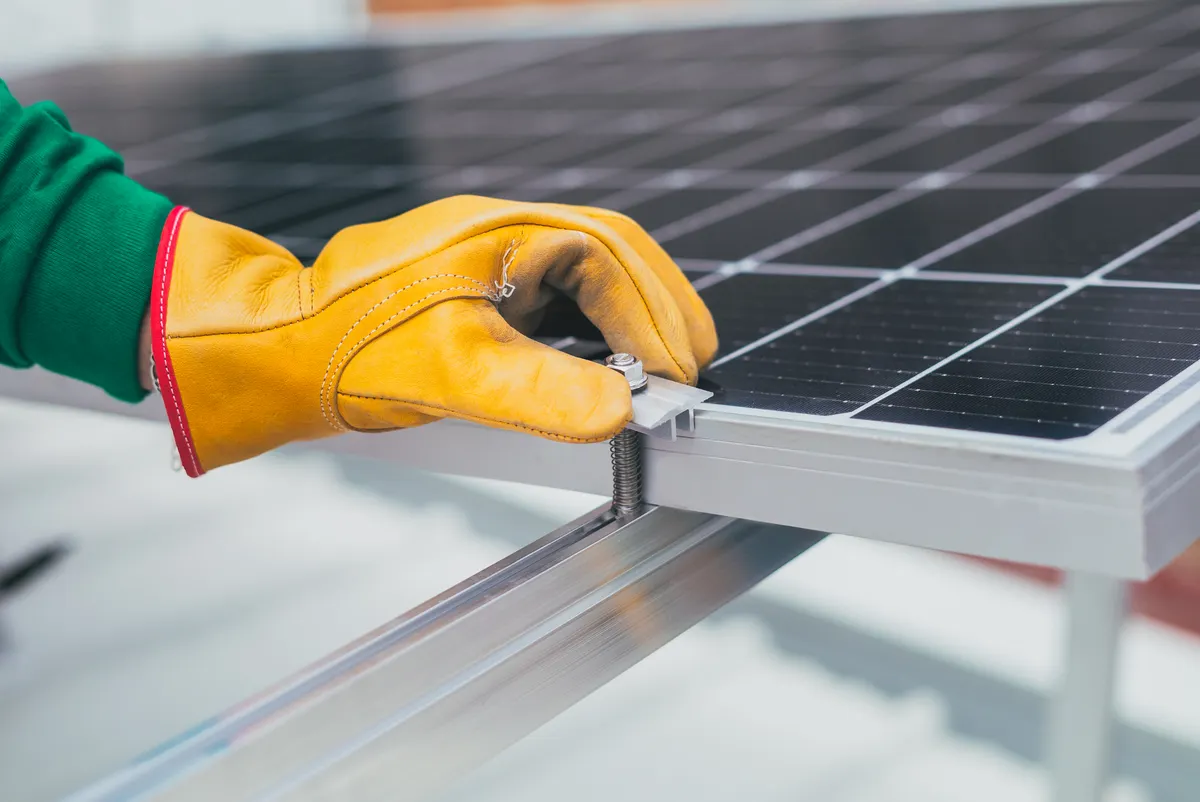
Rather than build proprietary hardware, Gritt’s approach is to take off-the-shelf equipment, rented skidders and robotic arms from manufacturers including Kawasaki, and layer its AI models on top. The system’s first task is precise: unloading large glass solar panels, ferrying them to metal frames, and positioning them to sub-millimetre accuracy so workers can bolt them in place.
The performance gap between a crew working with and without Gritt is the company’s central pitch. A typical eight-person team installs around 800 panels per day unaided. Working alongside Gritt’s systems, that same crew reaches 3,000 to 4,000 panels per day, according to Puri. The startup says its systems have already placed tens of thousands of panels on live projects with zero breakages, per Robotics & Automation News.
One unidentified customer told the original reporter that remote sites, where recruiting workers is especially difficult, could benefit most, and that repeated overhead lifting of 100-pound panels was a genuine injury risk the system helps remove.
Contracts, Competitors, and the Scope of the Ambition
Gritt currently has two systems deployed in the field, collecting data to sharpen their models. The company says it is contracted to assist with the installation of 2.8 gigawatts of solar capacity over the next 18 months, with customers including three of the top 10 US power construction companies. It expects to have 48 systems operating within six months.
The Dealroom data suggests the $26 million Series A sits in the 95th percentile for rounds of its stage in the construction and infrastructure robotics sector, which signals how thinly capitalised most competitors remain.
Those competitors include Luminous Robotics, Cosmic, and China’s Trinabot. All three are building their own hardware end-to-end, whereas Gritt is explicitly not. Whether vertical integration or Gritt’s asset-light model proves faster to scale will be one of the defining questions of the sector over the next few years.
Andrew Beebe, Managing Director at Obvious Ventures, led the round. His description of the founders’ appeal was direct: ‘There are people who used to build rockets that went into space and had infinite budget for the smallest little part, and then there are people who know what it means to get into dirty, dull, and dangerous jobs and scale them like mad. These guys are in the second camp, and that’s a special kind of entrepreneur that has the technical chops, the AI, and the machine vision skills to make it work.’
Beebe’s title in the original coverage was listed as partner; Robotics & Automation News identifies him as Managing Director.
Puri frames the technology in broader terms than panel-placement. ‘Our thesis is that if we truly want to speed up construction, you need an intelligence which can work in the outdoor, chaotic environments of these construction sites, and it has to be generalizable enough that it can work in these varied environments,’ he said.
Training new tasks onto the platform is accelerating. Teaching the system to stack cinder blocks took weeks; a comparable rebar-tying demonstration took a single day, using the same underlying software pipeline. Beyond installation, Gritt imagines its sensor suite flagging site risks in real time: an open trench as a storm approaches, missing inventory, scheduling gaps.
The next expansion targets for the hardware include fastening panels, drilling posts, and assembling the racking systems themselves. After that, rebar tying before concrete pours. The 2.8-gigawatt contracted pipeline is the immediate test of whether the field performance holds at scale.

