

In the middle of the 19th century, the Western world fell in love with balsamic vinegar. Italians were familiar with it for centuries and had been using it in the kitchen, on drinks, and even as medicine.
It must be its delicious taste that is so unique, the perfect balance of tart and sweet, and flavors that range from fruity to woody, or maybe its honey-like texture, balsamic vinegar is a dark syrup with glossy notes.
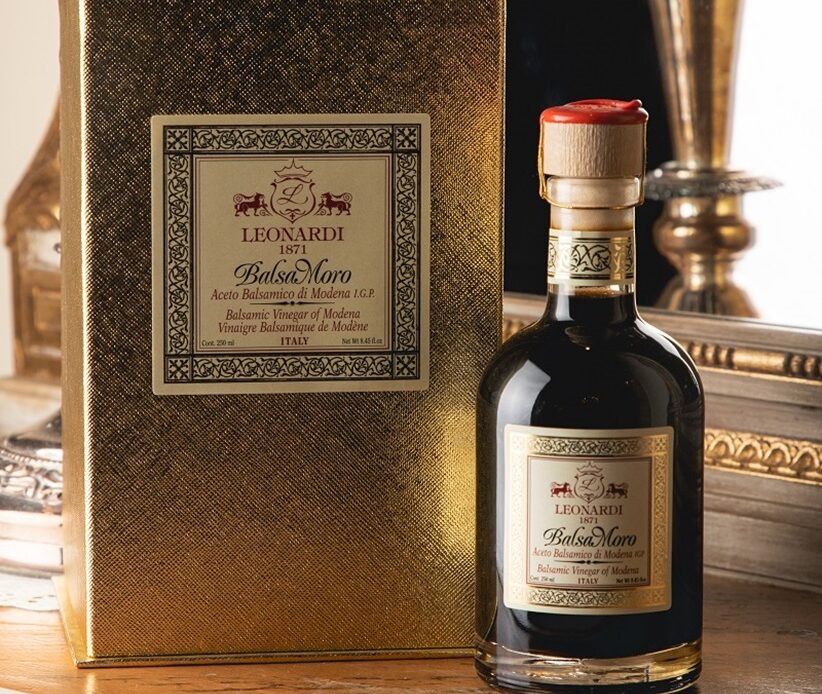
The Balsamic vinegar Acetaia Leonardi is one of our favorites right out of Modena, where balsamic vinegar is so precious that it is commonly known as dark gold.
Chefs around the world have embraced this ingredient and made it the protagonist of dishes that stand out. However, balsamic vinegar has also made its way into the average home. While many use it as a salad dressing or to marinate meats, the truth is that using good quality balsamic vinegar for those purposes is a bit of a waste.
There are several different kinds of balsamic vinegar and some imitations, usually called condiments. Maybe these last ones are better suited for salads, however balsamic vinegar with the denominations D.O.P. or I.G.P. are of much higher quality (thanks to its regulated production process).
The best balsamic vinegar is usually used to enhance dishes, decorate them, and add a tiny bit of flavor that can truly transform your cooking.
To go through everything you need to know about balsamic vinegar, we need to start from the beginning.
Where does balsamic vinegar come from?
As we mentioned, balsamic vinegar has a much longer history. First written records can be tracked to almost one thousand years ago.
The regions of Modena and Reggio Emilia, in Italy, are the places where balsamic vinegar was born and where it is produced still today.
The production of balsamic vinegar remains very much unchanged in its bases, and while technology has made its way into this industry, commitment to tradition and quality, as well as family values, play a massive role in how balsamic vinegar is made today.
The production of balsamic vinegar
Balsamic vinegar is made of a concoction of grapes cooked slowly. Once it’s reduced to half, the grape must, as it’s commonly called, is stored in wooden barrels where it will be aged. The aging process has a lot of steps, as basically the grape must is moved from bigger to smaller barrels and aged from 3 to over a hundred years.
Aging the grape must is what brings out the tart flavors and balances the sweetness, and the wood used in the barrels is what adds the fruity and woody flavor so characteristic of good quality balsamic vinegar.
Different kinds of balsamic vinegar
Balsamic vinegar comes in different varieties. And choosing the right one will make a huge difference in achieving the results you’re looking for.
The most appreciated balsamic vinegar is known as the Traditional Balsamic Vinegar of Modena D.O.P. As its name lets us imagine, there is a lot of tradition in the making of this balsamic vinegar. The D.O.P. denomination is quite strict on standards of production. Only certain grapes can be used, as well as the kinds of wood for the barrels. And the aging process is very much what it used to be hundreds of years ago.
Traditional balsamic vinegar of Modena D.O.P. is of the highest quality, and given its complex production process, it’s no surprise its price is probably above average.
There is also what’s called Balsamic Vinegar of Modena I.G.P. This denomination allows for more flexibility throughout the production, allowing acetaias (where balsamic vinegar is produced) to work at a faster speed, and therefore be able to deal with the ever-growing demand.
Finally, there are imitations and condiments. These are easily identified, even though they may still be called balsamic vinegar of Modena, because of the lack of denominations. In these cases, there are no recognized standards on how balsamic vinegar is produced and therefore the results can vary widely in terms of flavors and textures.

