


Steve Wozniak showed up. That alone should tell you something.
Apple’s co-founder appeared at DREAME AURORA’s Silicon Valley launch on April 29th — a gathering themed “Connect NEXT” that marked the brand’s formal entry onto the world stage. Not as a guest speaker tucked into the program. As someone exploring the next decade of tech development alongside the company. His presence carried weight.
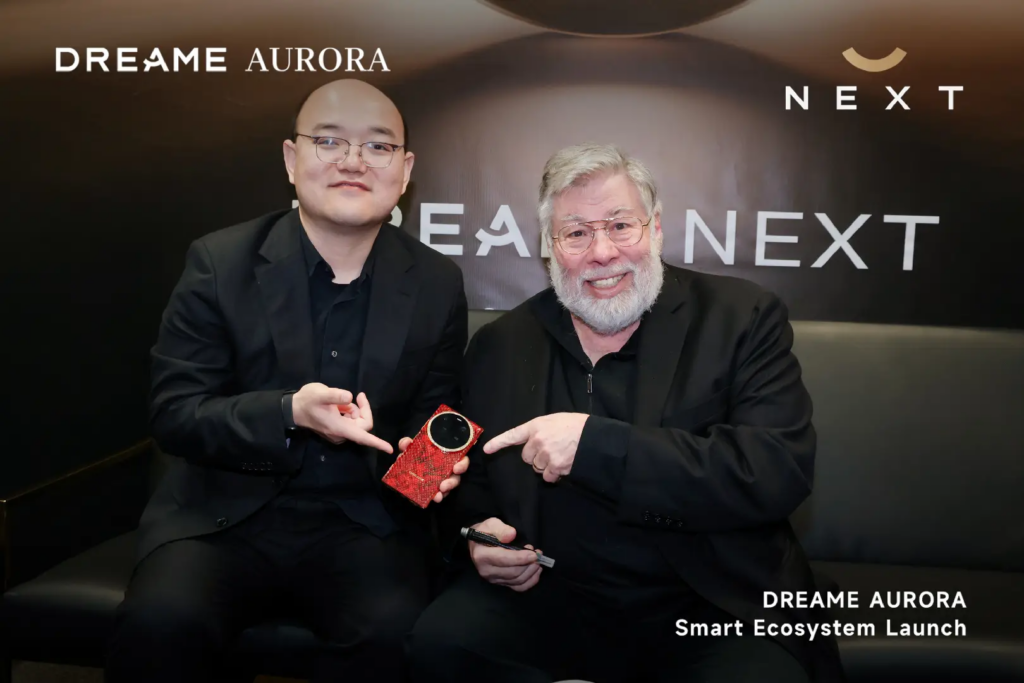
This wasn’t just a product launch. DREAME AURORA is planting a flag.
The brand arrives with a three-tier product structure that’s clearly designed to own as much of the premium market as possible without cannibalizing itself. At the top sits the LUX — built in collaboration with luxury design houses, pulling in jewelry-grade craft and intangible cultural heritage techniques alongside raw performance specs. Below that, the NEX functions as the company’s technology showcase: proprietary imaging algorithms, a modular architecture built for full-scenario use. Then there’s the standard Flagship Series, which packages imaging, connectivity, and AI into something more accessible for high-end mainstream buyers.
Smart architecture. Each tier has a distinct job.
The financial commitments backing this are serious. Over the next three years, DREAME AURORA is funneling major investment into three pillars: Imaging, Connectivity, and Systems. R&D headcount is scaling fast — and the company has made it clear that keeping R&D staff at a high proportion of the workforce isn’t a suggestion, it’s a standing rule. For imaging specifically, they’ve created a dedicated pre-research fund tied to a fixed percentage of annual revenue. The core imaging team averages more than a decade of industry experience. National-level photographers are embedded throughout testing — not reviewing results after the fact, but shaping them from a user’s eye.
Here’s where it gets interesting: DREAME AURORA doesn’t need to build retail from zero.
The brand can tap into the existing DREAME global retail footprint, setting up dedicated phone zones inside stores that are already operating. Flagship stores and official online channels will layer on top. That’s a meaningful head start — walking into markets with infrastructure already in place instead of burning capital to construct it.
On the technology side, a few things stand out. Imaging work has moved past the phase of selecting hardware components and into deep proprietary algorithm development. Full-focal-length 200MP capture, full-focal-length LOFIC, and 3D spatial-modeling photography are all approaching commercialization. The connectivity architecture covers 360° wrapping antennas, signal optimization algorithms, and dedicated weak-signal acceleration — and the team tested it hard, collecting raw signaling data in tunnels, international waters, and remote no-man’s-lands.
The Smart OS takes a different philosophical stance entirely: instead of users adapting to the device, the device anticipates and serves. Proactive delivery. Cross-application collaboration. Embedded intelligence from the kernel up.
The question isn’t whether DREAME AURORA has the technical ambition. It clearly does. The question is execution at scale — sustaining that R&D intensity while building a global consumer brand from scratch in a brutally competitive space.
But Wozniak doesn’t show up for brands that aren’t serious.

