
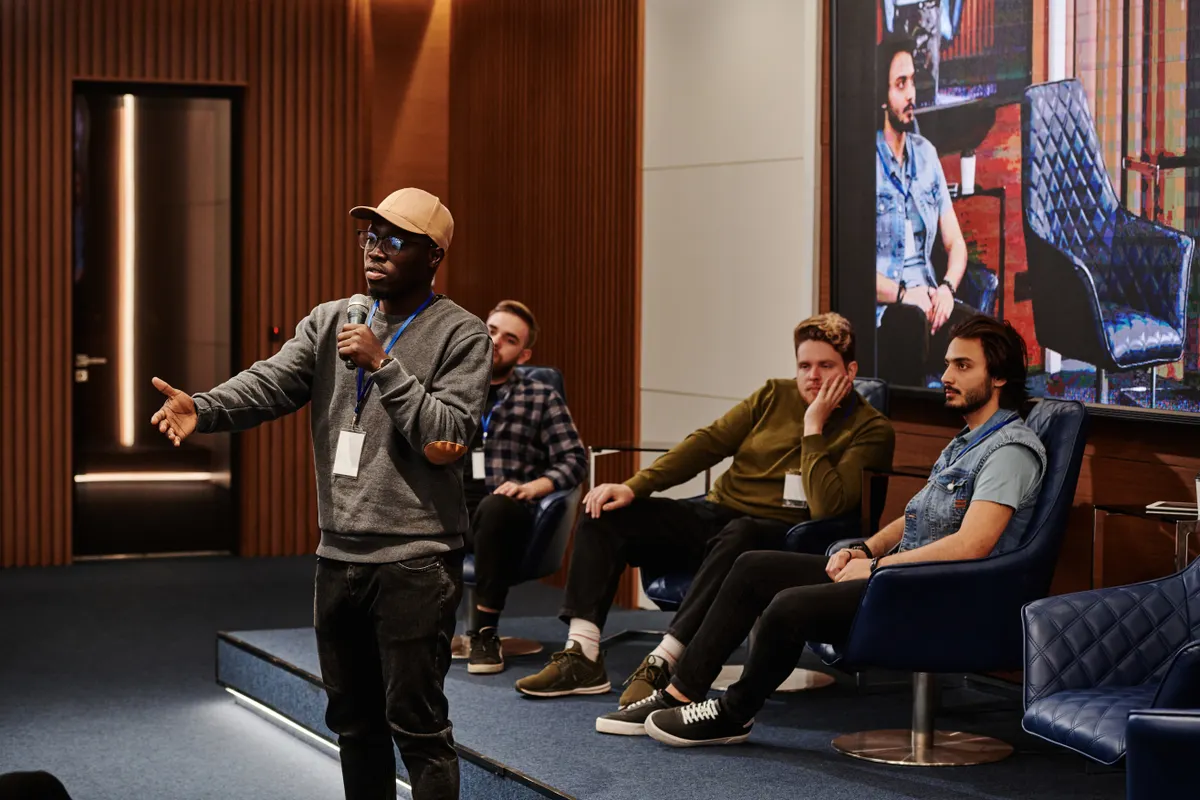

The Builders Stage at TechCrunch Disrupt 2026 returns this October with a roster of founders, venture investors, and operators tackling the questions that actually keep early-stage company builders up at night: how to raise before you have a product, how to hire when AI is eating the job description, and how to survive the jump from seed to Series A.
The event runs 13–15 October at Moscone West, 800 Howard Street in San Francisco, drawing more than 10,000 founders, investors, and technology leaders. THE D*AI*LY BRIEF’s Disrupt 2026 overview puts the programme at more than 200 expert-led sessions from more than 250 speakers, with over 300 startups exhibiting across six themed stages.
The Builders Stage is one of those six, dedicated specifically to the operational and fundraising decisions that determine whether a startup survives its own early traction.
What the Builders Stage TechCrunch Disrupt Agenda Actually Covers
The session list is built around four broad programming themes running across the full event: Building and Scaling, AI and the Physical World, Digital Finance, and Machines, Infrastructure and Energy. On the Builders Stage, the first theme dominates.
Several sessions address the AI elephant in every founder’s room. One panel, titled ‘What Happens When OpenAI Ships Your Roadmap’, brings together Michel Tricot of Airbyte, Rob Toews of Radical Ventures, and Linda Tong of Webflow to examine where defensibility actually lives when the largest AI labs can clone a product in a quarter. A companion session, ‘How to Win When You’re Not Building AI’, counters the hype with a case for efficient growth, retention, and revenue quality as the real differentiators.
The fundraising sessions carry some weight. ‘Winning Pre-Seed Without a Product’ dissects how founders build credibility before revenue exists. ‘The Series A in 2027’, featuring partners from Index Ventures, Peak XV, and Bessemer Venture Partners, lays out what ‘fundable’ will mean as venture standards tighten further.
On go-to-market, Ryan Meadows of Lovable and Tomasz Tunguz of Theory Ventures headline a session arguing that $0 to $10 million ARR is now the expected early-stage baseline, with the first 90 days framed as the decisive window.
One of the sharper speaker choices is Leah Solivan, who will appear in ‘The Zero-to-1K Playbook’ alongside Grant Lee of Gamma. Solivan founded TaskRabbit and scaled it over eight years into an international operation running across more than 44 cities, raising more than $50 million in venture capital before overseeing its acquisition by IKEA in 2017. She now manages a portfolio of more than 150 companies at Precedent.vc. Her presence in a session about landing the first thousand customers without a marketing budget gives the panel a practical floor most pitch-circuit appearances lack.
The AI Disruptors 60 and the Battlefield Prize
Two set-pieces punctuate the wider event. The centrepiece pitch competition, Startup Battlefield 200, offers a $100,000 equity-free prize with free entry rather than a pay-to-pitch model, according to the event overview.
Separately, Greenfield Partners will reveal its AI Disruptors 60 list live on 14 October. According to the AI Disruptors 60 official site, the reveal will be presented on the Nasdaq MarketSite tower in Times Square simultaneously, with submissions for the 2026 class having closed on 5 August. The session on the Builders Stage, hosted by Greenfield’s Shay Grinfeld, frames the reveal around the question of what AI systems can actually do in the field versus what they can only discuss.
The mental-health session, ‘Yes, It’s Hard to Be a Founder’, featuring David H. Rosmarin of Harvard Medical School alongside Nell Daly of Revenge Capital and Jack Withinshaw of Airspeeder, rounds out a programme that at least acknowledges the psychological cost of high-growth environments, not just the operational ones.
Passes and Exhibit Costs
Pass pricing runs from $199 for an Expo+ ticket to $899 for an Investor pass, with prices stepping up as October approaches, according to WhatIsWiki’s Disrupt 2026 guide; the snippet confirms savings of up to $330 are available before the next price increase. Exhibitors face a separate calculus: standard 6-foot table packages start at $12,500, covering branding, signage, and seating, with the reservation deadline set at 25 September 2026, per the Coin Pulse HQ exhibitor guide.
Additional speakers and sessions are still being announced. For founders planning to raise in the next 12 months, the Series A panel on the final day of the event is the one to watch.

