
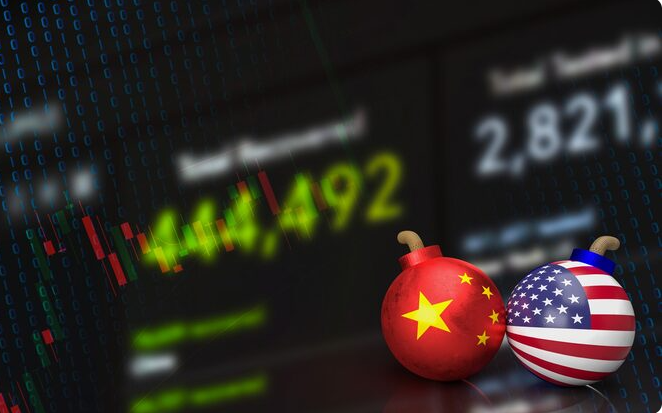

The anxiety on New York and Hong Kong trade floors doesn’t sound like yelling. It sounds as though there is no sound. As the yuan continues to decline against the dollar, traders gaze at currency charts in anticipation of indications that are rarely there. Almost courteously, the numbers advance slowly. But something more violent is developing beneath that serene exterior.
The U.S.-China currency battle has entered a new stage that feels less regulated and more intimate. What started out as tariff conflicts years ago has developed into something more complex: each nation is attempting to influence the value of its currency in order to obtain an edge. This change is more significant than most people think because currencies subtly affect everything from grocery prices to factory jobs.
Key Information Table
| Category | Details |
|---|---|
| Country | United States |
| Country | China |
| Key Currency | U.S. Dollar (USD) |
| Key Currency | Chinese Renminbi (Yuan, CNY) |
| Key Institution | Federal Reserve |
| Key Institution | People’s Bank of China |
| Major Issue | Competitive devaluation, trade imbalance |
| Global Impact | Trade, inflation, global markets |
| Reference | https://www.imf.org |
It was no coincidence that China permitted the yuan to depreciate beyond symbolic levels. It lessened the impact of US tariffs by lowering the cost of Chinese exports. It becomes clearer why that matters when you go through Guangdong’s export plants, where shipping containers wait to be transported. A contract’s survival or demise can be determined by even a slight change in currency.
The response was instantaneous in Washington. Openly claiming that a weaker currency would make it easier for American businesses to compete, President Donald Trump campaigned for lower interest rates. In the past, political pressure on monetary policy was uncommon. It seems nearly routine now. Economic restraint seems to be giving way to economic warfare.
The markets have reacted apprehensively. huge swings in stock values. Bond yields are declining as investors look for security. It is feasible to observe the subtle ways in which fear spreads by observing their movements. No one panics first. They just get ready.
Escalation is a deeper risk. With two countries, competitive devaluation rarely ceases. Observing closely, Europe and Japan might feel compelled to act to safeguard their own sectors. Global trade can be distorted in unanticipated ways by that ripple effect, which can spread swiftly. Once the chain reaction starts, it’s still unknown where it stops.
There are unsettling parallels in history. Countries actively depreciated their currencies in the 1930s in an attempt to snatch each other’s economic growth. Recovery was not the outcome. The instability was more profound. Today’s leaders are aware of that history, but knowledge does not always mean that it won’t happen again.
The reasons behind China’s actions are complex. Its economy has stalled, domestic tensions are increasing, and investment has started to move to nations like Vietnam. Allowing the yuan to depreciate provides short-term respite and buys time. However, if investors lose faith, there is a chance that money will leave the nation. That balancing act appears to be getting harder and harder.
America has its own paradoxes. Although the strength of the dollar indicates investor confidence, it also raises the cost of US exports. Although lowering the dollar would benefit manufacturers, it might also threaten the dollar’s hegemony in the world economy. For decades, the United States has had tremendous financial strength as a result of its supremacy. There are repercussions if you weaken it.
Tensions with technology exacerbate everything. Threats regarding rare earth materials and restrictions on firms like Huawei demonstrate how economic strife now affects every sector of the economy. The interconnectedness of these systems becomes clear as one stands outside Shenzhen’s electronics factory, where workers build cellphones under fluorescent lights. Everyone is at risk when they are broken.
Pride is also a factor. Neither party wants to come out as weak. These actions are rarely presented as defensive by political leaders. Rather, they portray them as essential. Controlled and strategic. However, currency battles tend to get out of control.
It’s difficult to ignore how invisible this issue appears to the average person. Tanks are absent. Not a single explosion. However, the repercussions could be equally important. accounts for savings. employment marketplaces. inflation. are subtly impacted by hidden changes in exchange rates.
Investors’ uncertainty about the future appears to be growing. Money is being transferred into gold by some. others into more secure government securities. Those choices imply readiness rather than assurance.
There is more than just financial harm at risk. There are no boundaries to this escalation. Because every nation enters the conflict when money itself is turned into a weapon.

