
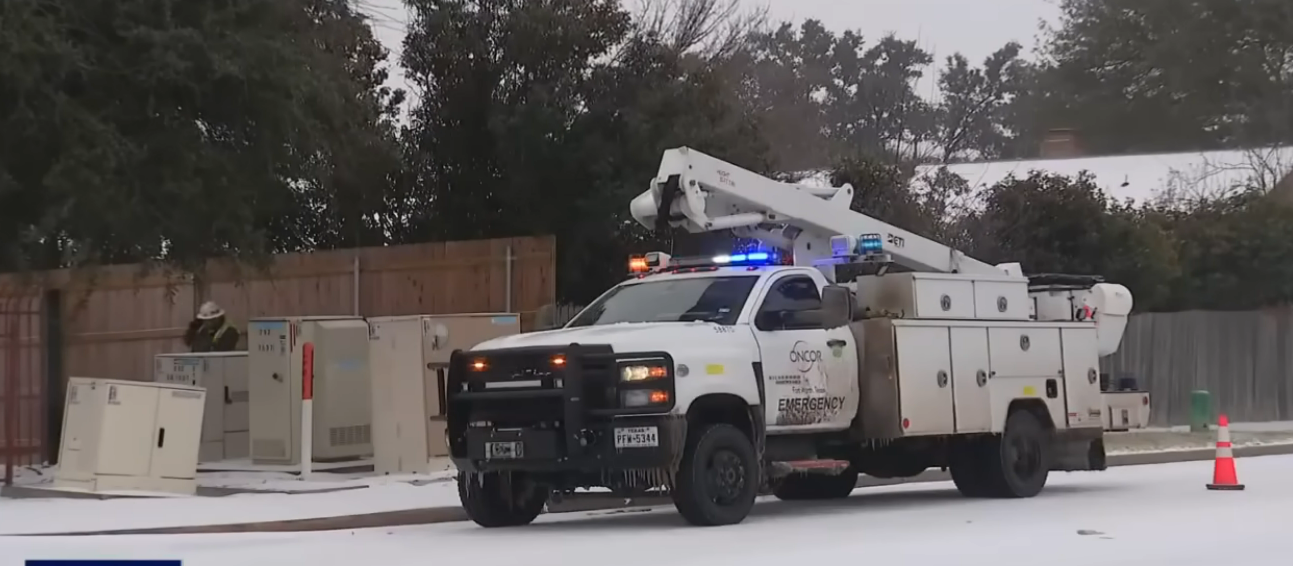

It began as a silent warning—a little dip in temperature, a few isolated flurries—and suddenly, nearly overnight, Fort Worth was encased in a layer of ice that transformed roads into frozen passageways and sidewalks into dangerous places.
Residents of Tarrant County awoke to the sound of sleet scratching windows and power flickers. The kind of cold that settles in and doesn’t go away. The kind that causes the creaking of even the strongest trees. It became evident early on Monday that this was not a typical freeze. Temperatures fell to 11°F, shattering records that had been in place since 1904 and laying the groundwork for one of the most disruptive cold outbreaks in recent memory.
There was silence in the streets. Not due to requirements or curfews, but rather because negotiating them became into a calculated risk. On bridges and in shady crossroads, the ice stubbornly persisted despite the efforts of brine trucks. Soon after, local businesses in Fort Worth closed for safety, while schools all around the city suspended classes. Events were halted, even the Stock Show, which is frequently a representation of the city’s tenacity, with its parking lots glistening with impassable frost.
By the middle of the week, emergency personnel were reacting to stranded drivers and fallen branches while working in shifts to restore power. The amount of extended outages was greatly decreased by the crews’ exceptional performance and well-coordinated efforts. Nevertheless, every zip code was affected by the disturbances. Some homes lost water after pipes failed due to pressure they weren’t designed to handle, and others were left without electricity for hours.
| Date of Event | January 15–17, 2026 |
|---|---|
| Weather Conditions | Freezing rain, sleet, record low temperatures |
| Coldest Temperature | 11°F (Jan 16), breaking 1904 record |
| Impacted Areas | Tarrant County, Fort Worth metro, rural outskirts |
| Major Disruptions | School closures, road shutdowns, power outages |
| Historical Context | Coldest January day in Fort Worth in over 120 years |
| External Reference | www.weather.gov/fwd |
I recall going outside onto my porch shortly after dawn during this span. The air remained still. There are no passing trucks. No barking dogs. Just the distant crack of tree branches under the weight of the ice and the metallic buzz of a neighbor’s generator. It served as a stark reminder of how easily contemporary comforts vanish when nature has other ideas.
However, this storm and the one we witnessed in 2021 had a lot in common. This time, however, the city wasn’t completely unprepared. Resources were prepositioned by municipal personnel. Communication with the public was quite straightforward. Furthermore, despite the strain, systems fared substantially better than they had five winters prior.
There were indications of careful learning in Fort Worth’s response. Warming stations throughout the neighborhood rapidly opened. School districts made a smooth transition to remote choices. Real-time mapping was utilized by utility providers to more precisely identify outages and deploy staff. Despite their flaws, these advancements were especially helpful in keeping people informed and comparatively secure.
That does not imply that the infrastructure is prepared for the future. Not at all.
Fort Worth is still expanding quickly, and as a result, there is an increased need for homes, roads, water, and energy. The electrical grid is still stressed even if it operated more consistently this time. Its design encourages moderate use rather than frequent cold snaps. When temperatures drop below freezing for prolonged periods of time, the water systems, which are many decades old, become vulnerable. It is now necessary for the city to switch from reactive adaptation to proactive resilience.
Nevertheless, there were positive signs of the strength of the community. Hot meals were available at local eateries for a fee. For warmth, residents who had fireplaces invited their neighbors inside. Emergency kits and blankets were given out by nonprofits. These little, frequently unexpected encounters had a big impact.
As usual, Fort Worth’s spirit came through in how it adapted to the storm rather than how it weathered it. Instead than waiting for someone else to take the lead, a lot of people took action while remaining silent. More than anything else, that made the freeze feel a little odd.
This freeze was not as severe or as long as the one in 2021. But there was no denying its intensity. It introduced astonishingly successful stress tests to both civic and physical systems. Furthermore, it was an especially crucial warning that climate extremes are real.
This storm should be examined as a preview rather than as an outlier in the context of long-term planning. Fort Worth’s resiliency must grow along with its westward and upward expansion. Temperature variations must be taken into consideration when designing roads. Thermal protection and energy efficiency must be added to building codes. Water infrastructure must be digitally monitored, buried deeper, and insulated.
Above all, communication must continue to be a top focus. During this freeze, the messaging was quite effective and obviously trusted. It was calm yet decisive. Panic is not beneficial to anyone. However, timely and accurate information about events and actions enables people to make well-informed decisions for themselves and their family.
It’s not about breaking the ice going ahead. It’s about navigating it with greater intelligence, speed, and readiness.
Fort Worth has started to learn, as this storm demonstrated. It no longer just reacts; it now anticipates. However, advancements must be maintained. The memory should remain intact even if the ice has melted. Every child who was unable to attend school, every car who slammed through an intersection, and every neighborhood that was silent—all of those things count.
They advise us on what needs to be strengthened, what needs to be fixed, and how to better defend one another in the future. Because the next time will come. And ideally, it would feel less like a disturbance and more like a city that has firmly and methodically adjusted to the upcoming season.

