
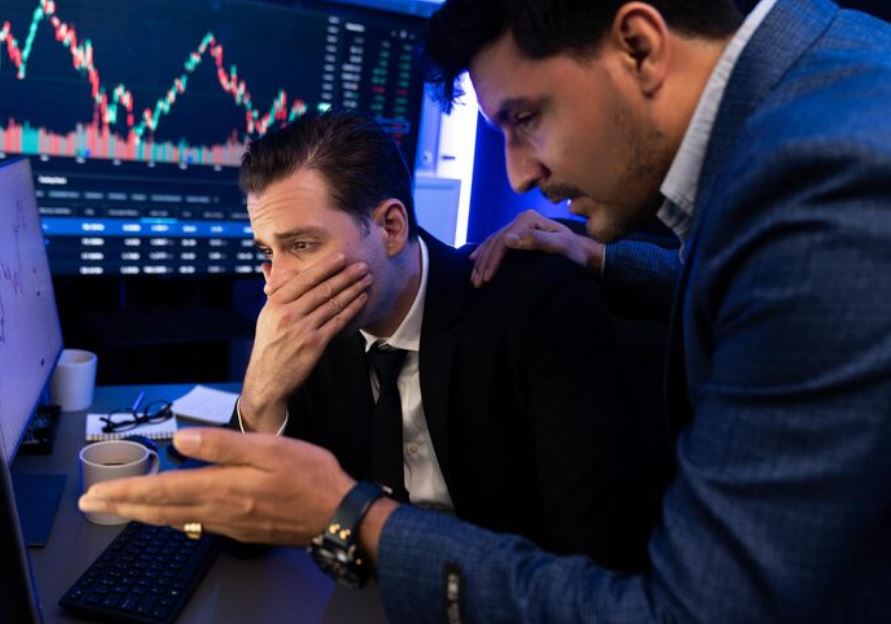

Driven by unrelenting enthusiasm for artificial intelligence and the conviction that this new technological wave can redefine the economic frontier, tech shares are once again driving market gains. Investors seem unwilling to blink as Alphabet’s value recently reached $3.5 trillion and Nvidia surpassed $5 trillion. Underneath the optimism, however, analysts are subtly speculating about an impending valuation storm that feels remarkably reminiscent of the late 1990s.
Google CEO Sundar Pichai put it succinctly. He stated, “There are aspects of irrationality as well as rational excitement.” He spoke with a humility that is uncommon for a CEO whose business is making a lot of money thanks to the AI revolution. Because he was one of the few insiders to admit that no tech giant, not even Google, is impervious to the whims of overconfidence, Pichai’s candor struck a chord.
| Focus Area | Description |
|---|---|
| Key Theme | Tech stocks soar to new highs on AI enthusiasm, though experts warn valuations are reaching unsustainable levels. |
| Major Companies | Alphabet (Google), Nvidia, Microsoft, Apple, Meta, Amazon, Tesla. |
| Primary Drivers | AI innovation, speculative trading, and investor euphoria amid optimism about productivity gains. |
| Current Concerns | Overvaluation, high corporate debt, and vulnerability to policy tightening. |
| Historical Context | Rising similarities with the late-1990s dot-com era, marked by extreme optimism before a sharp correction. |
| Reference Source | https://www.bbc.com/news/articles/cn88zvy2d5po |
It’s hard to ignore the déjà vu feeling. A wave of optimism surrounding the internet 25 years ago caused valuations to soar. Investors thought they were witnessing a revolution that would render the previous economic regulations outdated, just as they do now. Everything was altered by the internet, but not before a painful correction that depleted market capitalization by trillions. The enthusiasm surrounding AI today feels both exciting and risky, especially given that businesses are investing billions of dollars in data centers before their revenue models are completely established.
This tension is aptly captured by Nvidia’s explosive growth. Previously regarded as a specialized chipmaker, it is now the spokesperson for a movement. Almost every large company, including OpenAI and Meta, uses its technology to power their AI models. Every quarterly report is viewed by investors as a vote on the direction of intelligence in general. Analysts like Gil Luria of D.A. Davidson, however, have expressed concern, pointing out that a large portion of the AI boom’s funding is going toward highly leveraged infrastructure rather than tested commercial results. He emphasized that excitement has already surpassed caution, saying, “It’s the downstream debt that worries me.”
Volatility has taken over as the new beat on trading floors. Within a single session, the Nasdaq Composite has fluctuated between exuberant rallies and heartbreaking declines. The index’s 2.6% rise and 2.1% decline on a particular November morning serve as an ideal illustration of investor psychology. Fear overtakes hope more quickly. That day, Nvidia, Oracle, and AMD all exhibited the same pattern: an emotional pulse that resembles a reflex more than a logical analysis.
With a crucial distinction, economists are starting to draw cautious comparisons to the dot-com bubble. Unlike many startups in the past, the current giants—Apple, Microsoft, and Google—are incredibly profitable. Their infrastructure is sound, their product ecosystems are worldwide, and their balance sheets are strong. However, valuation is still a volatile indicator of faith in the future. When people stop questioning whether prices reflect fundamentals or collective imagination, even healthy companies can become overvalued.
Those who are willing to look can see the warning signs. Nearly 30% of the S&P 500’s total weight is currently held by its top five technology companies, which is comparable to historical peaks prior to significant corrections. Due to this concentration, there is now what traders refer to as a “market of monopolies,” where a small number of companies control the sentiment of investors worldwide. Dominance of this kind can be both extremely effective and extremely brittle.
Sociologically speaking, this is a cultural story rather than merely a financial one. Creating stories of innovation that combine aspiration and inevitable outcomes, Silicon Valley’s icons have evolved into contemporary mythmakers. With his trademark leather jacket, Jensen Huang of Nvidia now exudes the same symbolic authority as Steve Jobs. Standing ovations are given to him when he attends conferences, demonstrating how thoroughly the industry has integrated technological advancement with individual charm.
Another important factor in maintaining this boom is the involvement of retail investors. Social media forums and platforms like Robinhood have made stock trading a shared digital experience. Inspired by viral success stories, a lot of small investors view AI investments as a means of generating wealth. Access is becoming more democratic, which is both positive and dangerous. “The recovery is precarious, and investors know it,” said portfolio strategist Lauren Goodwin. The market’s rhythm is being driven by both financial and emotional stakes.
Optimism has spread to new parts of the world. Citing cross-border investment in AI-driven industries and digital expansion, Singapore increased its GDP forecast. Japan, meanwhile, started a $135 billion stimulus plan to boost innovation and exports. These actions demonstrate how technology has developed into an economic lifeline, a common hope for countries looking to grow in the face of greater uncertainty.
Even this optimism, though, has limitations. Pichai recently issued a warning, stating that AI already consumes enormous amounts of energy—roughly 1.5% of all electricity used worldwide. If clean energy innovation doesn’t happen quickly, the industry’s growth may put a strain on infrastructure and jeopardize sustainability objectives. The irony that highlights the fine line between ambition and responsibility is that the same executives who are issuing these warnings are also spearheading investments in remedies.
This story’s duality is its most fascinating feature. On the one hand, AI is a sign of true advancement—tools that can increase human potential, automate work, and cure illnesses. However, it’s feeding a financial cycle that is motivated by both logic and emotion. In a way, the market is human: aspirational, optimistic, and sometimes illogical.
The rally is ongoing for the time being. Every dip is viewed as an opportunity to enter, and every warning headline is viewed as background noise. The belief that the future belongs to those who dare continues to unite traders, investors, and technologists. How well this enthusiasm transitions from exuberance to maturity will determine whether that conviction is sustainable.
Even if there is a valuation storm, it might not be a catastrophe but rather a chance for resilience and a recalibration. The real test for the tech giants of this generation will be their ability to endure rather than how high they can soar. Perhaps the most comforting fact of all is that progress never goes in a straight line, but it always finds a way forward.

