
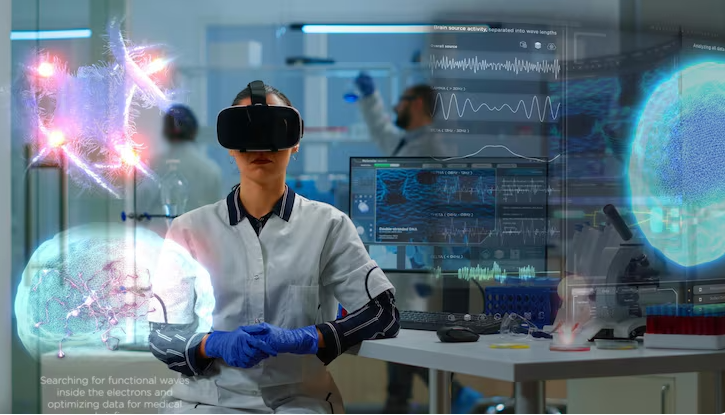

Time seems to stand still in a hospital hallway, right outside an imaging room. Nurses work swiftly yet silently, doctors examine scans, and patients wait. A large portion of medicine has been working at this speed for decades—careful, systematic, and frequently slow due to necessity. Something is shifting now. That timescale is starting to be compressed by artificial intelligence, often in uncomfortable ways.
Drug discovery is where the change is most noticeable. In the past, it could take years or even more than ten years to develop a new treatment. Large biological information, including genetic sequences, protein structures, and clinical records, are now being analyzed by AI models, sometimes cutting the process down to months. Protein structures may now be predicted with speed and accuracy that would have appeared unattainable a short time ago thanks to programs like AlphaFold.
Key Information About AI in Medicine
| Category | Details |
|---|---|
| Topic | AI in Medical Innovation |
| Core Areas | Drug discovery, diagnostics, clinical trials |
| Key Technology | Machine learning, computer vision, genomics |
| Breakthrough Tool | DeepMind’s AlphaFold |
| Impact on R&D | Reduces timelines from years to months |
| Diagnostic Accuracy | Up to ~90% in some cases |
| Clinical Trial Improvement | 30–50% faster timelines |
| Personalization | Tailored treatment via genomic data |
| Key Challenge | Data bias, privacy, regulation |
| Reference Website |
It seems as though the nature of discovery itself is changing as researchers engage with these systems. Scientists can investigate several options at once, led by algorithms that recommend which avenues are worthwhile, rather than manually verifying each hypothesis one at a time. This may not only speed up research but also alter the way questions are posed in the first place.
The effects are not limited to the lab. AI is starting to revolutionize procedures that have been essentially unaltered for decades in clinical trials, which have long been regarded as one of the most drawn-out stages of medical development. AI can find qualified applicants more quickly by evaluating patient data more efficiently, thus increasing enrollment rates. Adaptive trial designs are evolving, making real-time adjustments in response to incoming data.
This efficiency has an almost paradoxical quality. Clinical trials are made to be cautious in order to guarantee dependability and safety. The obvious question that arises when we accelerate them is if we are going too fast. As these tools become more commonly used, it’s still uncertain if the balance between speed and rigor can be maintained.
Another area where AI is becoming more noticeable is diagnosis. Algorithms are increasingly used in radiology departments to help read X-rays, MRIs, and CT images, frequently identifying patterns that are hard for the human eye to see. AI systems can detect tiny fractures, neurological abnormalities, and early-stage malignancies with extraordinary accuracy, sometimes surpassing that of conventional techniques.
It’s difficult to ignore how this alters the doctor’s job. AI appears to be changing expertise rather than replacing it. Physicians become interpreters of machine-generated insights and patient data, integrating algorithmic recommendations with clinical judgment. The question of whether this regularly produces superior results remains unanswered.
This change may feel most noticeable in the field of personalized medicine. AI can recommend treatments that are specific to each patient by combining information from several sources, including genetics, lifestyle, and medical history. For instance, algorithms in oncology examine tissue samples to forecast how a particular malignancy could react to various treatments. The notion of a treatment plan that works for everyone starts to wane.
Additionally, there is a subtle revolution taking place in the way that research is carried out. AI-powered “virtual labs” are starting to appear, in which self-governing systems study scientific publications, formulate theories, and model experiments. These mechanisms never grow weary. They don’t slow down. They investigate potential at a speed that is unmatched by human researchers.
However, the restrictions do exist. Data quality is still a problem. AI models are only as good as the data they are trained on, and in the medical field, that data may be inconsistent, skewed, or lacking. Because patient data must be managed extremely carefully, privacy considerations add another level of difficulty.
Additionally, there is a subtle conflict between reliance and trust. Systems that function as “black boxes,” producing outcomes without necessarily providing clear explanations, may be difficult for both doctors and patients to fully trust. The degree to which these technologies are embraced may depend more on transparency than on their actual performance.
When considering the bigger picture, the incorporation of AI into medicine seems more like a slow change on several fronts than a single breakthrough. Each field—drug development, diagnostics, and treatment planning—is changing in a unique way that adds to the overall change.
As this develops, it seems as though medicine is about to enter a new era in which accuracy and speed are no longer mutually exclusive. However, that presumption may be overly optimistic. The complexity of healthcare systems, human judgment, and technical competence all influence the more complex reality.
The pacing feels purposeful as I stand in that hospital hallway once more. Beneath it, however, a quicker process is taking place—an unseen layer of analysis, forecasting, and decision-making that was previously absent. The rhythm of medicine is not being replaced by AI. It’s quietly and gradually changing it, posing questions that the field is just now starting to address.

