
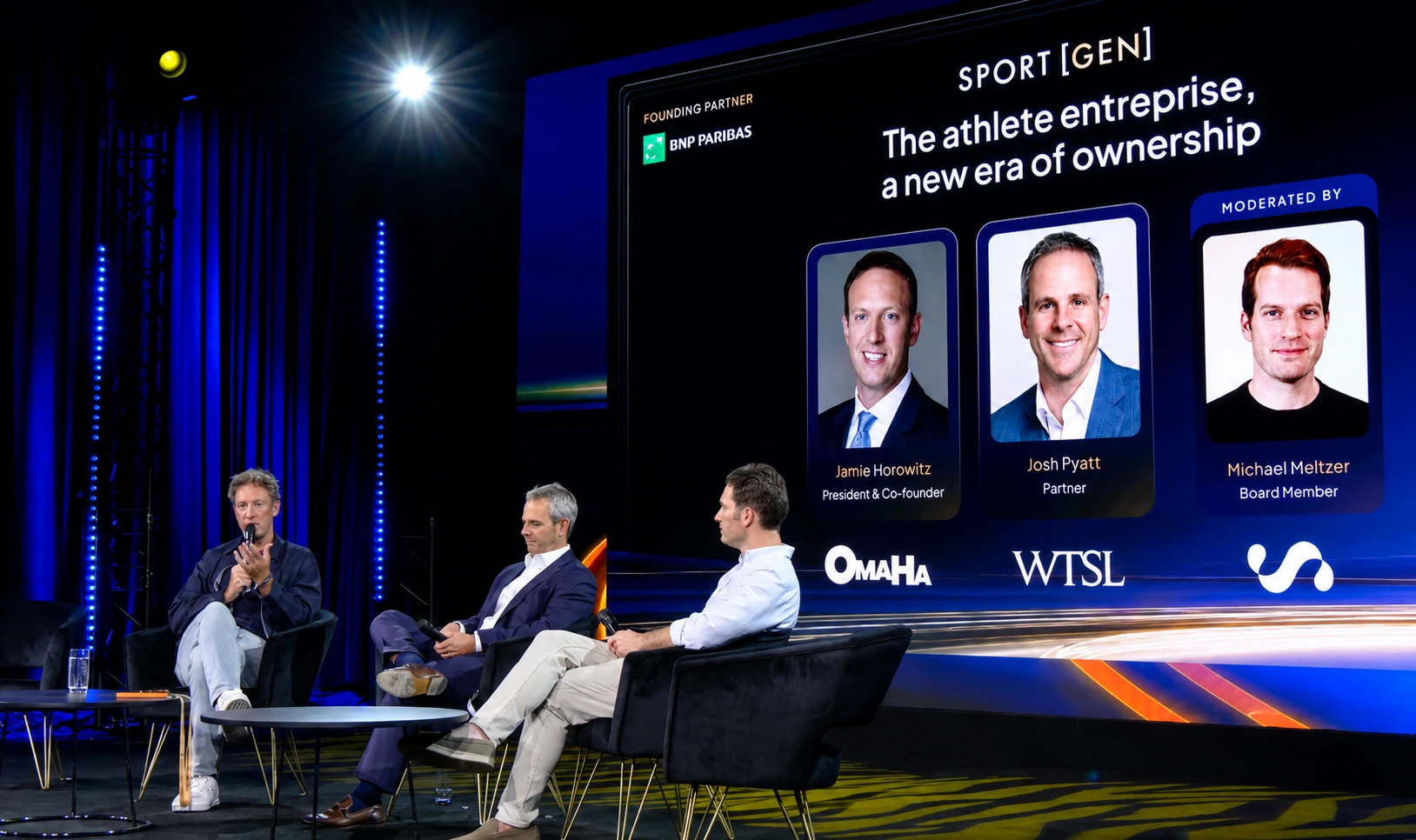

PARIS — Five years after co-founding Omaha Productions with Hall of Fame quarterback Peyton Manning, Jamie Horowitz is looking toward a new frontier: Europe.
Speaking at the SportGen Summit in Paris, Horowitz said the athlete-driven media company that has become one of the most successful businesses in sports entertainment is actively exploring opportunities on the continent, including partnerships with European athletes and brands.
“The Omaha model should work here,” Horowitz said. “We’ve been taking meetings here and we are interested in expanding into Europe.”
The comments came at the inaugural SportGen Summit, a new international sports business conference held during the opening week of Roland-Garros. The event brought together leaders from across sports, media and finance, including investor Marc Lasry of Avenue Capital Group, Monica Biagiotti of Mastercard, Vincent-Baptiste Closon of BNP Paribas, Teodora Ivanova of Morgan Stanley and Adnan Khalef of The Carlyle Group. Organizers positioned the summit as a forum for discussing the future of sports investment, media, technology and athlete-led enterprises, attracting more than 1,400 attendees from across Europe and North America.
The interest in Horowitz’s comments reflected Omaha’s rapid rise from startup to industry heavyweight. Founded in 2020 by Manning and Horowitz, the company began with projects such as the Emmy-winning ManningCast but has since expanded into one of the most ambitious businesses in sports media. Omaha produces hit Netflix series including Quarterback, Receiver and Starting Five, maintains a long-term partnership with ESPN, and has expanded into podcasts, advertising, live events and scripted entertainment.
Earlier this year, a Silver Lake-backed investment vehicle led by former Endeavor executive Patrick Whitesell acquired a minority stake in the company, valuing Omaha at more than $800 million.
In some respects, Omaha already has a foothold in Europe. Earlier this year, French media giant Mediawan acquired Peter Chernin’s North Road Company, which owns a minority stake in Omaha Productions. The transaction brought Omaha into the orbit of one of Europe’s largest independent media groups and created a new connection between the company and the continent Horowitz now hopes to expand into.
The comments also came during a panel that often felt as much like a tribute to Horowitz’s entrepreneurial success as it did a discussion about the future of athlete-led businesses.
Moderator Michael Meltzer introduced Horowitz as the co-founder and president of Omaha Productions, the company he built alongside Manning, describing Omaha as one of the rare athlete-driven media businesses to achieve meaningful scale. Meltzer noted that the company has grown to a valuation of more than $800 million and praised Horowitz and fellow panelist Josh Pyatt as “the masterminds and builders of the few companies that have actually worked” in the increasingly crowded athlete-media space.
Meltzer went even further, describing Omaha as “probably one of the biggest production companies in the world right now,” citing the company’s growing slate of programming that includes Emmy-winning projects and hit series such as Quarterback and Starting Five.
Yet throughout the conversation, Horowitz seemed intent on shifting the spotlight away from himself, repeatedly giving credit to Manning for Omaha’s vision, culture and success.
“When I hear you say we co-founded it, it’s a bit like saying Rafa Nadal and I combined for 22 Grand Slam wins,” Horowitz joked. “Technically accurate, but not quite the whole story.”
It was a revealing moment from the executive who has helped transform Omaha from a startup launched in late 2020 into one of the most valuable businesses in sports media. Throughout the discussion, Horowitz consistently redirected credit toward Manning, Omaha’s employees and the collaborative culture inside the company.
The message surfaced repeatedly: building a media company is ultimately a team sport.
“The company was started because Peyton had a genuine point of view on the world,” Horowitz said. “What he said was, ‘How can I bring people together?'”
That philosophy became the foundation of Omaha Productions, which launched with a mission to create what Horowitz described as “uplifting and unifying content.”
Unlike many modern production companies, Omaha has deliberately chosen not to pursue several lucrative categories.
“At Omaha, we don’t do crime, we don’t do religion, we don’t do politics, we don’t do investigative journalism, we don’t do takedown pieces,” Horowitz said. “All of these make money. But at Omaha, we can’t touch them because we have real brand values.”
Those values, he said, originated with Manning.
The partnership between Manning and Horowitz emerged as one of the central topics of the discussion, providing what many attendees viewed as a blueprint for successful athlete-led businesses.
Early in Omaha’s formation, Horowitz recalled telling Manning that simply lending his name to the venture would likely produce a successful company.
“I told him early on, ‘Peyton, if you just want to license your name, the company will be successful,'” Horowitz said.
Manning’s response became a defining principle.
“‘There’s nothing I do where I just give you my name for 20%,'” Horowitz recalled. “‘It’s either 100% all in, or I’m not doing the company.'”
That commitment has remained one of Omaha’s defining advantages.
“He works as hard as anyone in the company,” Horowitz said.
Pyatt, who Meltzer noted has helped build businesses with some of the most influential athletes of the modern era — including LeBron James, Kobe Bryant, Dale Earnhardt Jr. and Manning — argued that the Manning-Horowitz partnership illustrates why so few athlete-driven companies ever reach significant scale.
“And then probably the most important piece of all: having the Jamie,” Pyatt said.
For Pyatt, whose career has been spent helping elite athletes transform personal brands into lasting businesses, the lesson was that star power alone is rarely enough. The most successful athlete-driven companies pair iconic talent with an experienced operator capable of turning popularity into enterprise value.
Later in the discussion, Pyatt offered perhaps the strongest endorsement of Horowitz’s role in Omaha’s success.
“One of Jamie’s superpowers is getting Peyton to a place where he did everything for the benefit of the business, not just himself,” Pyatt said.
“A lot of athletes are used to: you pay me a million dollars, I show up and film a Coke commercial.”
Instead, Pyatt said, Horowitz helped Manning think beyond endorsement income and focus on creating a business with lasting value.
“When you pay the business, the business then has a multiple against it — you get paid ten times that later.”
The results have been significant.
When Omaha launched, roughly 80 percent of its content featured Manning. Today, Horowitz said, Manning appears in only about 20 percent of the company’s on-air programming.
“As we sit here today, he’s in 20% of the on-air work,” Horowitz said. “Now you have a real scalable business.”
The company has since expanded into partnerships with athletes including Eli Manning, Jayson Tatum and Justin Jefferson, creating what Horowitz described as “mini Omahas” that leverage the company’s infrastructure and expertise.
“What we provide are the 80 employees at Omaha who helped build this thing,” Horowitz said. “They’ll build it for you.”
That team-first approach surfaced throughout the discussion. Horowitz repeatedly emphasized the contributions of Manning and Omaha’s growing staff. The company’s success, he suggested, was less about any one individual than about creating an organization capable of scaling beyond its original star.
For Horowitz, that collaborative model may ultimately prove exportable beyond the United States. In some ways, the groundwork may already be in place. Through Mediawan’s acquisition of North Road, Omaha now sits within a broader media ecosystem that stretches across Europe, creating potential opportunities for partnerships, distribution and athlete-led ventures on the continent.
“If you ask me, ‘Do you think there will be an Omaha equivalent in Europe?’ — the answer is yes,” Horowitz said.
The challenge, he noted, is the same one that fueled Omaha’s success from the beginning.
“You have to pair the right athlete with the right executive.”
That pairing, Horowitz and Pyatt argued, remains rare. But as athlete-led businesses become increasingly sophisticated and investors pour capital into the sector, Europe may be the next market where the model takes hold.
For now, Omaha is exploring what that opportunity might look like. But judging by the reception Horowitz received in Paris, many in the sports business world believe Omaha may already have the blueprint.

