
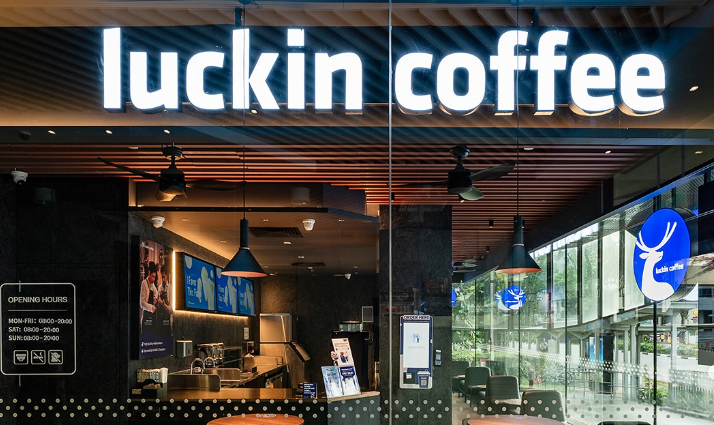

The first thing you notice when you enter one of Luckin Coffee’s flagship locations in Shenzhen is speed. As soon as they enter, patrons take out their phones after taking a quick look at a luminous menu board. Orders are placed using the Luckin app, baristas work quickly behind the counter, and a line of milk teas and iced lattes appears on a pickup shelf in a matter of minutes.
It feels more like a meticulously planned logistics operation than a typical café. Few observers thought Luckin Coffee would survive in this form just a few years ago.
| Category | Information |
|---|---|
| Company | Luckin Coffee Inc. |
| Industry | Coffeehouse Chain / Beverage Retail |
| Headquarters | Xiamen, China |
| Founded | 2017 |
| Major Investor | Centurium Capital |
| Total Stores | Over 30,000 locations globally |
| Recent Expansion | First U.S. café in New York City |
| Major Acquisition | Blue Bottle Coffee (reported ~$400M deal) |
| Strategy | Fast-service coffee + premium specialty brand |
| Reference Website | https://www.luckincoffee.com |
With an exceptionally aggressive marketing strategy, the company shot to prominence in 2018 by rapidly opening thousands of locations, providing drastically discounted drinks via a mobile ordering system, and attempting to take on Starbucks in China. The rate of expansion was really quick. And so was the ensuing dispute.
In 2020, a financial scandal almost ruined the company’s reputation. Luckin acknowledged to falsifying hundreds of millions of dollars in sales, prompting a collapse in its share price and driving the business off the Nasdaq exchange. The tale appeared to be ended to many onlookers at the time. Another overblown startup that failed due to its own ambition.
Centurium Capital, a private equity firm, intervened to help the turnaround while new leadership reorganized the business. The tone changed, but the tactic stayed forceful. Luckin focused on improving its operational model within China rather than on global buzz.
It has been hard to ignore the outcomes. With over 30,000 locations, the firm is currently among the biggest coffee chains worldwide. It’s difficult to ignore the recognizable blue emblem that appears on businesses every few blocks when strolling through business districts in cities like Shanghai or Shenzhen.
The way the Luckin experience differs from regular cafés is intriguing. For instance, Starbucks used atmosphere to establish its image throughout the world. There are cozy chairs, background music, and recommendations for patrons to stay for an hour or two. The strategy used by Luckin is nearly the opposite.
The majority of stores are built with efficiency in mind. Many places are tiny, often hardly bigger than the counter of a convenience store. Seldom do customers stay seated for very long. Making coffee quickly and keeping the line moving seems to be the clear objective.
That strategy makes sense in a nation where mobile payments account for the majority of everyday purchases. However, Luckin’s goals are now going beyond fast-service beverages.
The business closed a deal earlier this year to buy Blue Bottle Coffee, a chain of specialized cafes that Nestlé had previously owned. Industry analysts were somewhat taken aback by the rumored purchase price of approximately $400 million. A very different aspect of coffee culture is represented by Blue Bottle.
Slow brewing techniques, carefully chosen beans, and simple cafés where baristas converse with patrons about tasting notes are how the company established its name. It’s a world closer to artisanal wine than quick coffee.
The pairing appears strange at first. Convenience and affordability are key components of Luckin’s brand. Craftsmanship and premium price are the cornerstones of Blue Bottle’s identity. However, the acquisition might indicate a more comprehensive approach.
It’s not necessary for Luckin to alter its fundamental model. Alternatively, it might enable Blue Bottle to function as an upscale rival while Luckin maintains its hegemony in the fast coffee industry. Because of this division, the business may enter the specialized market without confounding consumers who are only looking for a quick dosage of caffeine.
There are already indications of how the plan might be implemented. According to reports, Centurium Capital, which supports Luckin, has started talks with Chinese malls where Starbucks Reserve stores have just shuttered. Blue Bottle cafés may soon open in some of those locations, bringing the high-end brand to new urban markets.
The timing seems deliberate. Coffee consumption has been continuously increasing in China, especially among younger urban professionals who view cafés as social gathering places as much as places to get drinks. Thousands of coffee shops can be found throughout large cities in what once appeared to be a tea-dominated culture.
Luckin seems committed to taking over every aspect of that market. The business has even started to venture outside of China once more. Recently, a Luckin café made its debut in the US when it opened in New York City. The action is both strategic and symbolic, indicating that the company is now again self-assured enough to conduct business globally.
It’s unclear if American consumers will adopt Luckin’s mobile-first strategy. In the US, habit and ambience are fundamental to coffee culture. Ordering straight from a barista is still preferred by many patrons than using a phone app. However, the experiment itself demonstrates Luckin’s openness to trying new things.
It’s difficult to ignore how drastically the story has shifted when observing the company’s direction. Luckin Coffee served as a warning about startup excess only a few years ago. These days, it looks more like a global retail machine, experimenting with new brand layers and establishing outlets at a startling rate.

