
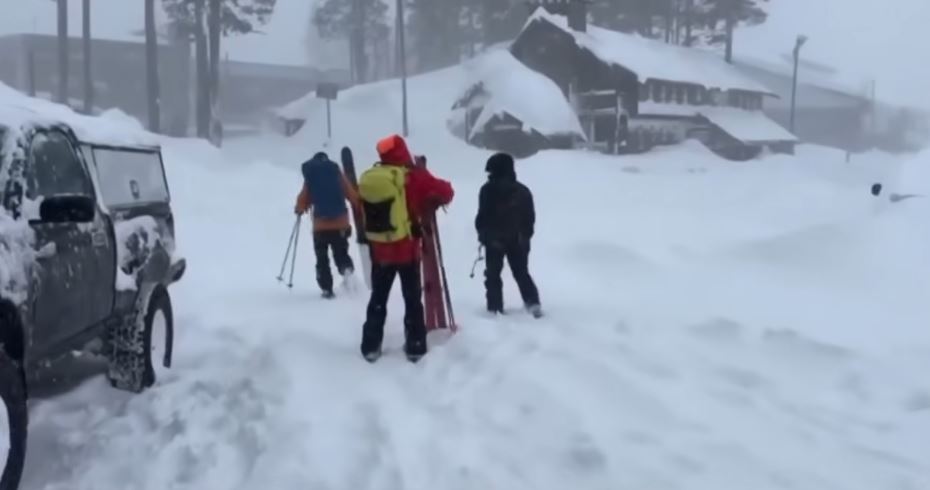

That morning, the snow appeared to be soft. The mountains outside of Truckee rose in recognizable white layers, their slopes gentle and welcoming, the kind of scenery that makes visitors want to return time and time again. Earlier ski tracks had solidified into subtle grooves, serving as a reminder that others had gone through without incident. There was nothing in the scene that hinted at what would happen next.
These mountains made sense to the women who perished here. They weren’t novices. Equipped with shovels, avalanche beacons, and the quiet confidence that comes from years of traversing hazardous terrain, they were seasoned backcountry skiers. Confidence might have made the mountains seem less intimidating than they actually were.
| Category | Details |
|---|---|
| Incident | Deadly avalanche during guided backcountry ski trip |
| Location | Near Castle Peak, outside Truckee, California |
| Mountain Range | Sierra Nevada |
| Victims Identified | Carrie Atkin, Liz Clabaugh, Danielle Keatley, Kate Morse, Caroline Sekar, Kate Vitt |
| Group Size | 15 skiers including guides |
| Notable Fact | Deadliest avalanche in modern California history |
| Reference | https://www.fs.usda.gov (U.S. Forest Service Avalanche Safety) |
They were looking for something easy.
Liz Clabaugh, Danielle Keatley, Caroline Sekar, Kate Vitt, Carrie Atkin, and Kate Morse were more than just skiers. Together, these mothers, professionals, and friends had established a custom of retreating into the Sierra Nevada. In order to carve out a few days of freedom, they coordinated work calendars, school schedules, and family responsibilities while planning trips months in advance.
These journeys seem to have been about more than just leisure.
They served as a reminder of their former selves before the demands of parenthood and work took over every hour. It’s difficult to find the same emotional reset elsewhere as standing on ridgelines, taking in the crisp air, and laughing at little slip-ups.
It was an avalanche that came swiftly. According to investigators, it happened close to Castle Peak, at a height where snow could be released from slopes above with terrifying speed. That week, there had already been avalanche warnings, which predicted unstable conditions and significant snowfall. However, seasoned skiers frequently proceed cautiously through such forecasts, relying on their guides and their own judgment.
Whether a single choice led to the catastrophe is still up for debate.
Avalanches are rarely explained simply. According to experts, they are a series of events that stack subtly until gravity takes over, including weather, terrain, timing, and human movement. Usually, there is nothing anyone can do once the snow starts to move.
When rescuers arrived, the landscape had changed. The slope was covered in debris fields, the snow broken and jagged by its own violence, and no longer smooth. Equipment was strewn about. Skis stuck out of the ground at odd angles. The mountain, which had been a happy place just a few moments before, had changed completely.
Another layer of heartbreak was caused by storm-slowed recovery efforts. Families awaited the slow-to-arrive news. Even the safe approach of rescuers was hazardous due to the weather. Given that loved ones were present but inaccessible, it’s difficult to ignore how cruel that delay must have felt.
Grief came in more subdued forms in the neighborhoods of San Francisco and Marin County where the women lived.
Counselors at the school were ready to talk to kids who had lost mothers. Meals were delivered by neighbors. Conversations were quiet and unfinished as the front doors slowly opened and closed. In these close-knit communities, grief spreads swiftly and leaves a lasting impression.
Coworkers recalled Kate Vitt as a warm and driven individual who had established a career in technology while raising two sons. Caroline Sekar was characterized by her neighbors as “sunshine,” someone who smiled readily. Her sister, Liz Clabaugh, had worked in the medical field for years, assisting people in their own times of need.
They now have to bear that burden on behalf of others. Throughout the skiing community, the avalanche has raised challenging issues. Thanks to better gear and social media photos of unspoiled snow, backcountry travel has become more and more popular in recent years. More people are stepping outside of resorts in search of challenge and solitude.
However, the mountains don’t modify their risks to appeal to more people.
Modern equipment seems to give the impression of control. Forecasts, airbags, and avalanche beacons increase the chances of survival, but they cannot completely remove uncertainty. Preparation has no effect on the mountains.
When victims did everything correctly, it is more difficult to accept that reality.
The women respected avalanche safety, according to friends. They practiced. They got ready. They employed qualified guides. Their passing calls into question the reassuring notion that survival is assured by experience alone.
It doesn’t always. Now standing close to Castle Peak, the snow has started to cover the ancient rubble. Physical evidence is erased by wind, which smoothes the surface. It will soon appear unaltered once more, beckoning others to appreciate its splendor.
Rarely do mountains disclose their past. One gets the impression from watching this happen that more than six lives were lost. A belief in predictability, in preparation as protection, and in the notion that love for a place guarantees safety there also vanished.
But people will come back. Because those who love the mountains still hear their call. And because living fully had always included answering that call for those who perished here.

