
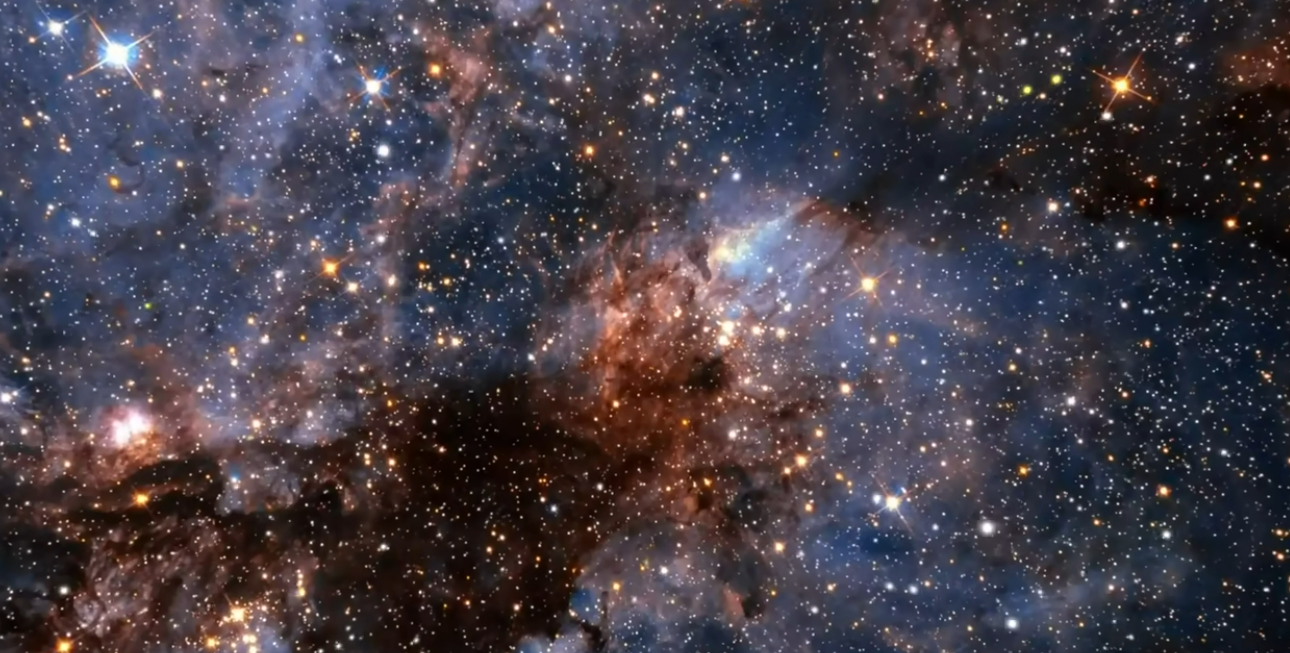

Astronomers characterized the interval between stars for decades as being sparse and unremarkable, a cosmic gap that was best described by what it lacked rather than what it contained. This view has significantly improved since then. Our galactic neighborhood appears to be a network of corridors, subtly molded by forces that terminated millions of years ago, rather than a blank expanse, as suggested by the discovery of an intergalactic tunnel.
The tunnel starts inside the Local Hot Bubble, a large area of unusually thin, hot gas that surrounds the Sun. This was not a gentle bubble. Repeated supernova explosions cut it, each exploding outward like overlapping shockwaves, gradually clearing a cavity and scorching what was left behind. One location where that pressure seems to have escaped is the interstellar tunnel, pushing forward rather than distributing uniformly.
With the eROSITA X-ray telescope, scientists found a remarkably similar pattern over wide swathes of the sky: regions where X-ray emissions intensify and dust drastically thins. This combination suggests that lengthy, weak channels of plasma—hot, electrically charged gas—stretch outward. These channels are wide passageways rather than slender tubes, resembling river valleys in shape.
| Feature | Description |
|---|---|
| Name | Interstellar Tunnel |
| Location | Extends from the Local Hot Bubble near the Sun toward Centaurus & Canis Major |
| Composition | Superheated, low-density plasma |
| Origin | Formed by ancient supernova explosions |
| Size | Estimated hundreds to over 1,000 light-years long |
| Discovery Tool | eROSITA X-ray telescope (Max Planck Institute) |
| Primary Significance | Connects our solar system to other star-forming regions in the Milky Way |
| Misconception | Not a wormhole; not suitable for travel |
| Potential Function | Acts as a channel for cosmic rays, dust, and stellar wind |
| First Published Research | Astronomy & Astrophysics, 2024–2025 |
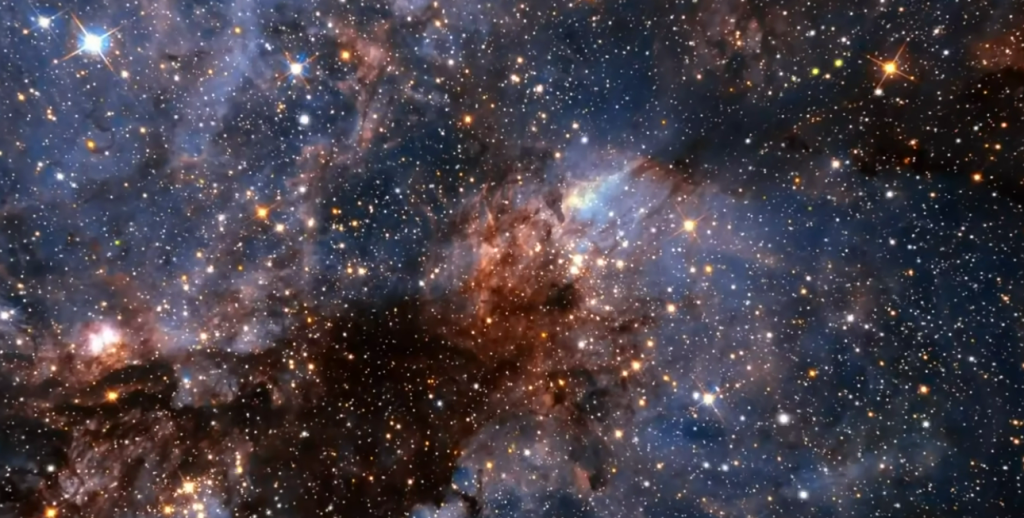
This discovery is especially intriguing because, once explained, it appears quite typical. Supernovas erupt. The shock waves grow. The least-resisting path is followed by gas. Those pathways coincide, overlap, and endure over time. Structure instead of chaos is the end outcome. It turns out that space arranges itself in an unexpectedly consistent way.
The length and purity of the tunnel leading to Centaurus make it stand out, albeit it is probably not the only one. Researchers believe there may be other extensions beyond the current detection limits, and a second extension seems to extend into Canis Major. When taken as a whole, they suggest that the Milky Way is made up of a larger lattice of interconnected cavities that were created long before the Sun appeared.
Realizing we live inside a building we’ve only recently been aware of has a subtle disquieting quality.
Because they have an impact on the movement of materials over great distances, these tunnels are especially useful from a scientific perspective. Cosmic rays, dust grains, and star winds follow gradients of density and pressure rather than moving at random. By directing that flow and influencing the potential locations for the formation of new stars, an intergalactic tunnel serves as a kind of backroad.
This matters because equilibrium is essential to star formation. Material is prematurely clumped by excessive dust and gravity. Clouds won’t collapse if there is too little. These plasma pathways participate in the regulation of that balance by dispersing material. Over geological timeframes, they are incredibly dependable, but they are not dramatic agents.
One thing that has to be clarified right away is that this tunnel is not a shortcut. It does not allow spacecraft passage, collapse distance, or bend spacetime. Any substance that is known would be destroyed by the temperatures alone. However, it would be a mistake to discount it due to its lack of cinematic flair. It is not about how stories move, but rather what it tells about the evolution of galaxies.
This finding also clarifies the confusion of past observations. It’s hard to measure a structure while seated inside of it. It is similar to attempting to map a forest while standing among the trees, depending more on subtle gradients, temperature variations, and sporadic light than on distinct outlines. Because of eROSITA’s distance from Earth’s X-ray glow, this task was much quicker and noticeably more accurate.
A three-dimensional image of the Local Hot Bubble was created by researchers by splitting the sky into thousands of observational parts. The outcome was far but seamless. It is formed by overlapping explosions rather than a single event, and it stretches, pinches, and bulges. Once pressure found an opening and continued, the tunnel appears.
I paused over one visualization and thought about how much this resembled subsurface cave systems that had been sculpted by water in the past.
The story is given more weight by a temporal component as well. Long after the supernovas that created it, the Sun just entered this bubble a few million years ago. We are at a favorable, if coincidental, position close to the middle. By studying the structure from the inside, astronomers can learn things that would be impossible to learn from any other location.
Plans are currently in place for further research. Increased sensitivity in X-ray surveys, enhanced dust mapping, and improved plasma simulations are expected to uncover more corridors and elucidate their connections. Eventually, what appears to be a single tunnel could develop into a coherent network, with each branch narrating a different chapter of the galaxy’s violent history.
Though subtle, the larger lesson is compelling. Space is a dynamic environment. Events that have long-lasting effects change, reshape, and repurpose it. One such echo, a remnant of explosions that ceased before Earth formed but that continues to influence matter flow now, is the interstellar tunnel.
Comprehending these frameworks does not guarantee quicker trips or simple solutions. It provides context instead. It demonstrates the surprisingly resilient effects of star death and the true interconnectedness of our surroundings. This makes the interplanetary tunnel more of a record than a passageway, one that is written in time, emptiness, and heat.

