
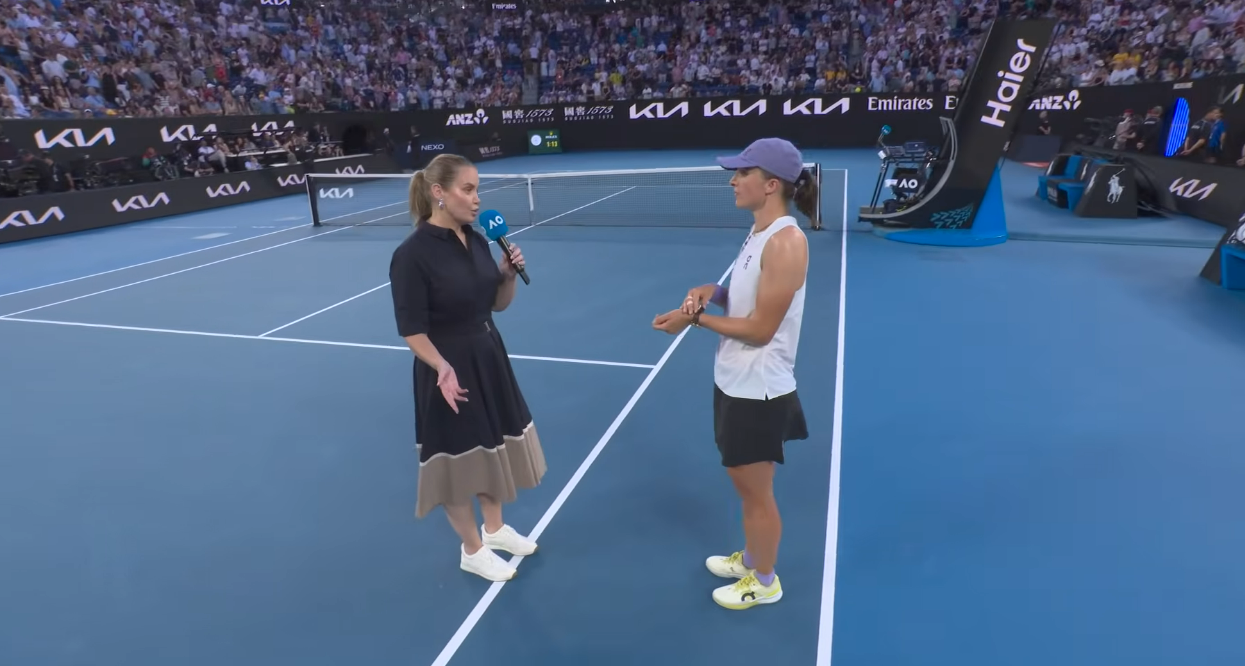

Maddison Inglis’s fans flooded the stands with enthusiastic applause on Monday afternoon as the momentum shifted in his favor at Rod Laver Arena. In just three games, the atmosphere had changed. It was not because Inglis didn’t play well, but rather because Iga Świątek was playing at an unstoppable level—effective, self-assured, and incredibly efficient.
She doesn’t use physical force to subdue opponents. She dismantles them. Every rally is conducted with control, and every choice is filtered through tactical clarity, giving the style an engineered feel. •ątek did not celebrate the 6-0 victory in the first set, which took just over thirty minutes to complete. She just turned and walked away. Her concentration was not just clear, but remarkably consistent.
Her peaceful control is what gives her presence such a unique quality. When a winner resets, other players may yell after her. That kind of self-control has come to define her brand and is especially helpful in stressful situations. Early in the second set, Inglis broke, but Świątek did not respond. Rather, she replied by winning the next five games with no fuss, as though the disturbance had only served to refocus her.
Świątek has significantly enhanced her ability to adjust mid-match during the last few seasons. She no longer looks anxiously at her player’s box. They were replaced by deep, quick breaths, deliberate rituals, and a keen stare that shows she’s still thinking—still solving.
| Name | Iga Natalia Świątek |
|---|---|
| Nationality | Polish |
| Birthdate | 31 May 2001 |
| Career Titles | 6 Grand Slam titles (as of Jan 2026) |
| Current Ranking | WTA World No. 2 |
| Education & Family | Daughter of Dorota and Tomasz Świątek, sister Agata |
| Coach | Wim Fissette (since 2024) |
| Known For | Precision baseline play, mental composure, clay court mastery |
| Reference | www.wtatennis.com/players/326408/iga-swiatek |

When I watched her at the French Open last year, she talked about pressure as something to absorb rather than something to run from. She stated, “It’s just a part of the process.” She approaches matches in a way that is somewhat similar to an architect going over blueprints: she checks angles, looks at minutiae, and makes sure each layer supports the one before it. In terms of how younger athletes see mental toughness, that way of thinking has been very creative.
Her statistics against Inglis were very obvious. Twenty winners. Her first serve won her more than 80% of the points. Five of the six break-points were scored. However, the atmosphere she generates on the court is hardly conveyed by numbers. With its crisp lines, consistent rhythm, and anticipatory rather than reactive movement, her footwork creates an almost artistic environment.
Świątek has established a career based on excellence and repetition rather than spectacle through purposeful refining. That is particularly uncommon in a time when showmanship frequently triumphs over planning. She increases her margins rather than seeking highlight clips.
Through working with the sports psychologist and improving her routines, Čątek has greatly decreased the emotional outbursts that previously disrupted her flow. She continues to be incredibly effective during games, saving time and effort that benefits her even after a tournament is over.
Even though she is only 24, she plays with an experienced logic that many veterans never fully grasp. Her collaboration with Wim Fissette, which started in 2024 and focuses on serve variation, more aggressive court placement, and confidence under pressure, has proven especially helpful. The results of that collaboration are encouraging, and it’s reasonable to think she will play in even more Grand Slam finals in the future.
Świątek continued to rise during the 2025 season without having to adjust her public image as rising stars like Rybakina and Gauff made headlines. Her voice was not louder. She didn’t do more marketing. She just continued to show up and succeed. During an unexpected tour, that consistency is extremely adaptable.
She never seemed to lose her composure, even in the face of losses, such as her sudden early withdrawal from the US Open last year. She went over the footage, changed her position on high balls, and resumed practicing rather than offering an explanation. It was a very commendable answer.
When she later told reporters, “Losing doesn’t change what I’ve built,” I found myself quietly moved. It was structural resilience rather than just humility. Instead, she was upholding a system, not a reputation.
The story of Čątek is particularly intriguing in the perspective of sustained brilliance. Many athletes fall and spike. She has laid the groundwork. By prioritizing long-term self-control over momentary drama, she is establishing herself as a very dependable competitor and role model for individuals who view tennis as a lifetime endeavor.
She contributes more than simply technical skill to women’s tennis. It is a timeless illustration of how intelligence, emotional clarity, and constancy can nevertheless prevail over volatility. And that’s not only amazing, it works incredibly well.
There is little doubt that the match will be close as she gets ready to take on Rybakina in the upcoming round. However, Świątek’s advantage isn’t based on fear. Data, drills, and the kind of quiet assurance that cannot be faked are its foundations. She’s engineering greatness rather than merely pursuing it.

