
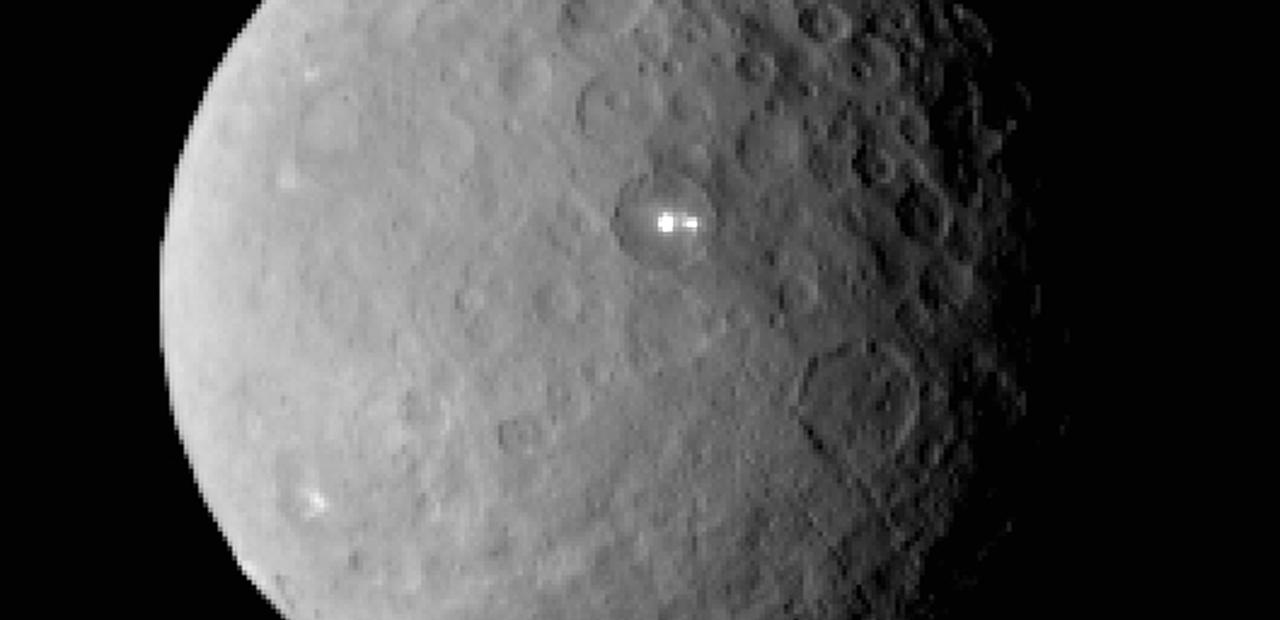

NASA Probe Dawn About To See First Glimpse OfCeres In March
The Dawn spacecraft from NASA is set to orbit around adwarf planet called Ceres in March 2015. According to scientists, the planet may be a potentially habitable alien world. It is the biggest planet between the asteroid beltofMars and Jupiter. The body is wet and is relatively warm. As Jian-Yang Li, whois with the Planetary Science Institute in Tucson, Arizona said, “I don’t think Ceres is less interesting in terms of astrobiology than other potentially habitable worlds.” The planet is 590 miles wide and has an abundance of water.
Ceres Has Solar Rays As Source Of Energy
Other than water, whichmakes up around 40% of the planet, Ceres also has an abundant source of energy through solar rays. The planet is only 2.8 astronomical units (AU) from the sun, while Europa and Enceladus are around 5.2 and 9 AU away respectively. Earlier this year, scientist said that they noticed water-vapor emissions from Ceres and that the planet may also have a subsurface ocean. Of course, the other reason for the vaporscould be that the water beneath the surface may heat up due to solar rays and water vapors coming out of it.
Dawn Is The Latest Hope For Studying Ceres
At present, the scientists are not very sure about the dwarf planet. For them, Dawn is the only hope that will let them know whether the planet is habitable or not. It will provide information about Ceres’s geology and thermal conditions. Other than that, there is the Atacama Large Millimeter/submillimeter Array, or ALMA which had the ability to penetrate deeper than Dawn into the subsurface of Ceres and give more information to the scientists.

